Introduction: The Evolving Power Paradigm for Mission-Critical Facilities
The Data Center Power Trilemma
>40%
Projected CAGR for AI-related Data Center Power Demand by 2028
>2,000 GW
Generation & Storage Capacity in US Interconnection Queues, Leading to Delays
100%
Pressure from ESG Mandates to Decarbonize Mission-Critical Operations
The landscape of data center development is being fundamentally reshaped by a confluence of powerful forces. The exponential growth of data, supercharged by the voracious computational demands of artificial intelligence and machine learning, is creating an unprecedented surge in power consumption. Projections indicate that data center electricity demand could exceed 1,000 TWh by 2026, creating immense strain on electricity grids (Source: iea.org). This demand is colliding with the reality of an aging grid infrastructure, which is increasingly prone to instability and congestion. Consequently, interconnection queues for new large loads have ballooned, with wait times stretching for years in many regions, posing a significant risk to project timelines and financial viability.
This challenging environment forces data center operators to reconsider their traditional reliance on the grid, elevating the importance of robust on-site power generation and resiliency. The historical standard, diesel or natural gas backup generators, is now being challenged by the maturation of utility-scale Battery Energy Storage Systems (BESS). BESS offers a compelling alternative, promising instantaneous response, zero on-site emissions, and the potential for new revenue streams.
This article provides a definitive technoeconomic framework to dissect this critical decision. By analyzing the technical capabilities, capital and operational costs, environmental impacts, and operational risks of both natural gas peaker plants and BESS, we aim to equip data center developers, investors, and operators with the comprehensive analysis required to select the optimal on-site power solution for their mission-critical facilities in this new era.
Section 1: Defining the Data Center Power Challenge
Core Power Requirements for Data Centers
99.999%
Uptime
The "Five Nines" imperative, translating to <5.26 minutes of downtime per year.
±5%
Power Quality
Strict voltage tolerance to prevent sags and swells that damage sensitive IT hardware.
>90%
Load Factor
Near-constant, high power demand, unlike typical commercial or industrial loads.
24/7/365
Resiliency
Ability to operate independently from the grid during extended outages.
The power requirements of a modern data center are among the most stringent of any industry. The foundational principle is uptime, quantified by the "five nines" standard—99.999% availability. This translates to less than six minutes of unplanned downtime per year, as even seconds of interruption can result in catastrophic data loss and millions in lost revenue. Beyond simple availability, power quality is paramount. Sensitive servers, storage arrays, and networking equipment are highly susceptible to voltage sags, swells, and harmonic distortions, which can cause logic faults, equipment degradation, and premature failure.
Unlike typical commercial buildings with variable loads, data centers exhibit a remarkably high load factor, often operating at over 90% of their peak capacity around the clock. This creates a massive, consistent baseload demand that must be met with unwavering stability. Superimposed on this challenge is the growing influence of Environmental, Social, and Governance (ESG) mandates. Hyperscalers and enterprise clients are increasingly demanding that their digital infrastructure be powered by clean energy, pushing operators to minimize their carbon footprint and on-site emissions. This confluence of extreme reliability, pristine power quality, high demand, and sustainability pressures necessitates a solution that can not only provide backup power but also ensure grid-independent resiliency and align with corporate environmental goals.
Section 2: Technical Deep Dive: Natural Gas Reciprocating Engine Peaker Plants
Natural Gas Genset: Key Performance Characteristics
Operating Principle
Fuel combustion drives pistons (RICE) or a turbine (SCGT) to spin an electric generator.
Start-Up Time
Typically 1-10 minutes from a cold start to synchronize and accept full load.
Infrastructure Needs
Gas pipeline connection, emissions control (SCR), noise enclosures, large physical footprint.
Primary Advantage
Long-duration, high-capacity power generation limited only by fuel supply.
For decades, on-site fossil fuel generation has been the cornerstone of data center resiliency. While simple cycle gas turbines (SCGT) are used for larger, utility-scale applications, the dominant technology for data center-scale projects is the Reciprocating Internal Combustion Engine (RICE). These systems operate much like a car engine, using the combustion of natural gas to drive pistons connected to a crankshaft, which in turn spins an electrical generator. RICE units offer higher efficiency at partial loads and faster start-up times compared to SCGTs, making them better suited for backup and peaking applications.
Performance Metrics
Key performance metrics for gas peakers include start-up time, which can range from one to ten minutes to reach full capacity, a critical gap that must be bridged by an uninterruptible power supply (UPS) system. Their ramp rates—the speed at which they can increase or decrease output—are slower than BESS but sufficient for following most load changes once online. Efficiency is measured by heat rate (BTU/kWh); modern RICE units feature heat rates between 8,000-9,500 BTU/kWh, translating to 35-42% electrical efficiency.
Physical and Logistical Requirements
Deploying a gas peaker plant involves significant logistical hurdles. It requires a dedicated, high-pressure natural gas pipeline, a considerable physical footprint for the engines and switchgear, and extensive civil works. Furthermore, environmental regulations necessitate complex emissions control systems, such as Selective Catalytic Reduction (SCR) to mitigate NOx, and substantial noise abatement enclosures to meet local ordinances. These requirements add complexity and cost to the project lifecycle. Maintenance is also a major consideration, involving regular servicing and periodic major overhauls that require specialized technicians and significant downtime.
Section 3: Technical Deep Dive: Battery Energy Storage Systems (BESS)
BESS: Anatomy and Key Metrics
System Architecture
- Cells/Modules: Li-Ion (LFP, NMC) chemistry stores energy.
- BMS: Brains of the system; monitors health and safety.
- PCS: Inverter/rectifier; converts DC to AC and back.
- Thermal Mgmt: HVAC system maintains optimal cell temperature.
Performance Metrics
- Response Time: <20 milliseconds. Instantaneous.
- RTE: 85-95%. Efficiency of a charge/discharge cycle.
- Duration: 1-4+ hours. Key design and cost parameter.
- Degradation: ~1-2.5% capacity loss per year.
Battery Energy Storage Systems represent a paradigm shift from mechanical, combustion-based power to solid-state, electrochemical technology. The dominant chemistry for grid-scale applications is Lithium-ion, with Lithium Iron Phosphate (LFP) becoming the preferred choice due to its enhanced safety, longer cycle life, and avoidance of cobalt.
System Architecture
A BESS is more than just batteries; it's an integrated system. At its heart are the battery cells, assembled into modules and racks. The Battery Management System (BMS) is the critical control layer, monitoring the voltage, current, and temperature of every cell to ensure safe and optimal operation. The Power Conversion System (PCS), a sophisticated bi-directional inverter, converts DC power from the batteries to grid-synchronous AC power and vice versa for charging. Finally, a robust thermal management system, typically HVAC-based, maintains the batteries within a narrow temperature band to maximize performance and lifespan.
Performance Metrics
BESS performance is defined by a unique set of metrics. Its most significant advantage is a near-instantaneous response time, measured in milliseconds. This allows it to function as a seamless UPS, eliminating the need for separate flywheel or traditional UPS systems and providing superior power quality conditioning. Round-Trip Efficiency (RTE), typically 85-95%, measures the energy lost in a full charge-discharge cycle. C-Rate defines the rate of charge/discharge relative to capacity, while Duration (e.g., 4-hour) dictates how long the system can discharge at its rated power.
Key Technical Constraints
The primary constraint is finite duration; unlike a gas peaker, a BESS cannot run indefinitely. This makes it critical to size the system's energy capacity (in MWh) for the facility's specific risk profile. Performance degradation is another key factor; batteries lose capacity over their lifetime, necessitating an augmentation strategy where new cells are added mid-life to maintain rated capacity. Finally, safety is governed by strict codes like NFPA 855, requiring advanced fire detection and suppression systems.
Section 4: The Economic Analysis Framework: Key Financial Metrics
Comparative Economic Drivers
A robust technoeconomic analysis hinges on a comprehensive evaluation of lifetime costs and potential revenues. Comparing a gas peaker and a BESS requires looking beyond the initial price tag.
Capital Expenditures (CapEx)
On a pure $/kW basis, a gas peaker plant often appears to have a lower upfront cost than a multi-hour BESS. However, the all-in installed cost must account for gas interconnection, extensive civil work, and emissions control systems for the peaker, versus the more modular, containerized installation of a BESS.
Operational Expenditures (OpEx)
Here, the models diverge sharply. A gas peaker's OpEx is dominated by the volatile and often unpredictable cost of natural gas, along with significant maintenance for its complex mechanical systems. A BESS, in contrast, has no fuel cost. Its OpEx consists of predictable, fixed-cost O&M contracts, parasitic load for thermal management, and a planned-for mid-life battery augmentation cost to counter degradation.
Levelized Cost of Energy/Storage (LCOE/LCOS)
To create an apples-to-apples comparison, LCOS is the critical metric. It amortizes the total lifetime costs (CapEx, OpEx, financing, decommissioning) over the total MWh delivered, providing a holistic view of the cost per unit of energy. For a detailed LCOS model tailored to specific project parameters, industry platforms and professional services can provide invaluable insights; consider exploring options after you https://jisenergy.com/sign-up-login/.
Impact of Incentives
The Inflation Reduction Act (IRA) has fundamentally altered the economic landscape. The availability of a 30% Investment Tax Credit (ITC) for standalone energy storage—which can increase to 50% with domestic content and energy community adders—dramatically reduces the effective CapEx of a BESS, often making it cheaper on a post-incentive basis than a gas peaker (Source: energy.gov).
Revenue Stacking Potential
Unlike a gas peaker, which is purely a cost center for reliability, a BESS can become a revenue-generating asset. By enrolling in ancillary service markets, a BESS can sell services like frequency regulation, spinning reserves, and demand response to the local grid operator, creating a significant value stream that offsets its costs and improves the overall project ROI.
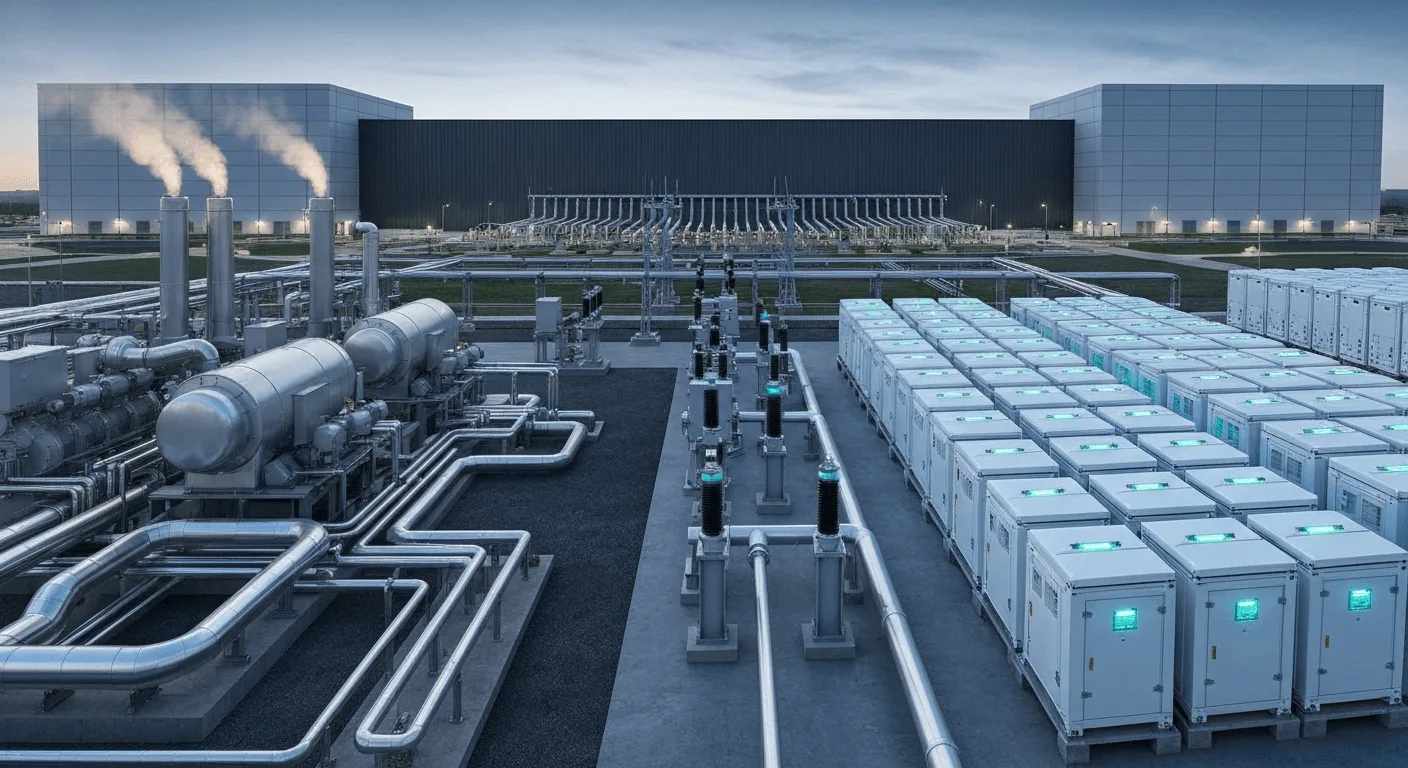
Section 5: Head-to-Head Comparison: Operational and Environmental Factors
Operational & Environmental Scorecard
Beyond pure economics, several operational and environmental factors weigh heavily in the decision-making process, often tilting the scale in favor of one technology over the other.
Permitting and Siting
This is arguably the greatest operational hurdle for gas generation. Permitting a gas peaker involves air quality permits, noise ordinances, fuel line approvals, and often faces significant "NIMBY" (Not In My Backyard) community opposition. This process can add 12-24 months or more to a project timeline. BESS projects, with no on-site emissions or major noise, typically face a much simpler and faster local permitting process, which can be a decisive advantage in fast-moving data center construction schedules.
Emissions Profile
A gas peaker is a direct source of Scope 1 on-site emissions, including nitrogen oxides (NOx), carbon monoxide (CO), and particulate matter (PM2.5), which are increasingly regulated. A BESS has zero on-site emissions. Its environmental impact is tied to the Scope 2 emissions of the grid electricity used for charging. As grids become greener, the lifetime carbon footprint of a BESS continuously improves.
Fuel & Supply Chain Risk
Gas peakers are exposed to the long-term price volatility of the natural gas market and potential physical supply disruptions. BESS technology is exposed to geopolitical and pricing risks within the battery mineral supply chain (lithium, cobalt, nickel). While both face supply chain risks, the fuel risk for gas is a perpetual operational variable, whereas the mineral risk for BESS is primarily concentrated in the upfront procurement.
Power Density and Land Use
For space-constrained data center campuses, power density (kW/sq-ft) is a critical metric. Modern BESS solutions are highly compact and containerized, offering a superior power density compared to the larger footprint required for gas engines, their extensive cooling systems, emissions controls, and mandatory safety setbacks. Similarly, the significant noise from operating gas engines requires extensive and costly abatement, whereas the hum from BESS inverters and HVAC is minimal and easily managed.
Section 6: The Hybrid Solution: Optimizing for Reliability and Cost
The Hybrid Power Response Timeline
Scenario: Grid Outage Event
Instantaneous Response (0-10 min): BESS provides seamless, UPS-quality power, bridging the gap as the gas generator starts up.
Extended Outage (>10 min): Gas generator takes over the load for unlimited duration, allowing the BESS to recharge or stand by.
The choice between gas and batteries is not always a binary one. A hybrid solution, strategically coupling BESS with gas generation, often represents the optimal approach to maximize reliability, mitigate risk, and enhance economic returns. This model leverages the distinct strengths of each technology to create a system more resilient and versatile than either could be alone.
System Design
In a typical hybrid architecture, the BESS is placed "in front" of the gas generators. It acts as the primary source of backup power, providing the instantaneous, millisecond-level response required to seamlessly carry the data center's load the moment a grid anomaly is detected. This eliminates the need for a separate, traditional UPS system. The gas generators are designated for long-duration outages, configured to automatically start up after the BESS has taken the load.
Operational Strategy
The operational logic is elegant: the BESS handles all short-duration outages and power quality events, which constitute the vast majority of grid disturbances. This is its "sweet spot," where its high efficiency and fast response excel. It also serves to "black start" the facility if needed. The gas gensets are only called upon for rare, extended blackouts lasting several hours or days, preserving their operational life and minimizing emissions, fuel consumption, and maintenance costs. During normal operation, the BESS can still participate in grid services for revenue generation, while the gas gensets remain available for N+1 redundancy.
This hybrid approach is particularly well-suited for Tier III and Tier IV data centers, where multiple, independent power paths and fault tolerance are mandatory. By combining the instantaneous reliability of BESS with the long-duration energy security of gas, operators can achieve an unparalleled level of resiliency while still capturing the significant financial benefits of the ITC on the battery portion of the system.
Section 7: Application Case Study: Technoeconomic Modeling of a 50 MW Data Center
50 MW Data Center: Decision Matrix
| Metric | Model 1: Gas Peaker | Model 2: BESS (4-hr) |
|---|---|---|
| Post-Incentive CapEx | ●●●●○ (Lower) | ●●●○○ (Higher) |
| 10-Year OpEx (NPV) | ●●○○○ (High & Volatile) | ●●●●● (Low & Predictable) |
| Revenue Potential | ●○○○○ (None) | ●●●●○ (Significant) |
| Permitting & Timeline | ●●○○○ (Slow) | ●●●●● (Fast) |
| ESG Alignment | ●○○○○ (Poor) | ●●●●● (Excellent) |
To crystallize the trade-offs, we model a hypothetical 50 MW greenfield data center located in a grid-congested region with strong corporate ESG commitments. The facility requires a backup solution capable of supporting the full load.
Model 1 Analysis (Gas Peaker)
* **Sizing:** A 50 MW N+1 configuration using multiple RICE units.
* **CapEx:** Estimated at $1,000/kW all-in, including gas interconnection and emissions controls, for a total of **$50 million**.
* **10-Year OpEx Forecast:** Dominated by fuel costs (assuming monthly testing and 24 hours of annual outage operation), plus major maintenance overhauls. The Net Present Value (NPV) of OpEx is highly sensitive to gas price volatility but is estimated at **$8-12 million**.
* **Timeline & Emissions:** Permitting is projected to add 18 months to the project. The on-site emissions profile presents a significant challenge to corporate ESG goals.
Model 2 Analysis (BESS - 4-Hour Duration)
* **Sizing:** A 50 MW / 200 MWh LFP battery system.
* **CapEx:** Pre-incentive CapEx is estimated at $350/kWh, totaling **$70 million**. After applying a conservative 40% IRA ITC (including an energy community adder), the effective CapEx is reduced to **$42 million**.
* **O&M & Revenue:** 10-year OpEx, including a capacity augmentation reserve, is estimated at an NPV of **$5 million**. Crucially, participation in the regional ancillary services market is projected to generate **$1.5-2.5 million** in annual revenue, significantly offsetting costs. (Source: NREL Annual Technology Baseline).
* **Timeline & Emissions:** Permitting is streamlined, estimated at 6-9 months. The system has zero on-site emissions.
Comparative Financials
The Gas Peaker has a lower initial CapEx, but its higher, volatile OpEx and lack of revenue make it a pure cost center. The BESS has a lower post-ITC CapEx and, once ancillary revenue is factored in, its 10-year NPV is substantially superior. The IRR for the BESS as a standalone investment (considering revenue streams against cost) can be positive, whereas the IRR for the gas peaker is infinitely negative. The payback period for the incremental cost of the BESS over the gas peaker, when accounting for revenue, can be as low as 5-7 years. The decision matrix clearly shows that while gas wins on upfront cost before incentives, BESS dominates across OpEx, revenue, timeline, and ESG—the metrics increasingly driving modern data center development.
Conclusion: Selecting the Right Power Strategy for the Future
Simplified Decision Tree
→ Lean towards a BESS solution. It offers zero on-site emissions and a significantly faster permitting timeline.
→ A Hybrid Solution (BESS + Gas) provides the best of both worlds: instant response and unlimited duration.
→ A standalone BESS can act as a revenue-generating asset, potentially offering a superior ROI.
The analysis reveals a clear and compelling shift in the power paradigm for data centers. The traditional choice, a natural gas peaker plant, offers proven, long-duration reliability but is increasingly burdened by high and volatile operational costs, lengthy and complex permitting, and a significant environmental footprint that is misaligned with modern corporate ESG mandates. In contrast, Battery Energy Storage Systems, supercharged by the transformative economics of the Inflation Reduction Act, present a powerful alternative. BESS delivers superior power quality, instantaneous response, a faster path to deployment, and zero on-site emissions. Its ability to generate revenue through grid services fundamentally changes its economic profile from a passive insurance policy to an active, value-generating asset.
However, the verdict is not universal. The optimal choice is intrinsically linked to site-specific conditions. A data center in a region with a less stable grid and a low-value ancillary services market may still find the long-duration assurance of a hybrid gas-and-battery system to be the most prudent path. Conversely, a facility in a renewables-rich region with a dynamic grid market and strict emissions standards will find a standalone BESS to be the obvious economic and strategic winner. The load profile, corporate risk tolerance, and local utility tariffs all play a decisive role.
Looking forward, the technological landscape will continue to evolve. The emergence of commercially viable long-duration storage technologies (beyond 8 hours) and the development of hydrogen-ready turbines may further reshape this analysis. For now, the imperative for data center developers is clear: a detailed, site-specific technoeconomic feasibility study is no longer a preliminary step but a core requirement for any successful project. Moving beyond simplistic CapEx comparisons to a holistic analysis of lifetime cost, revenue potential, and non-financial risks is essential to building the resilient, sustainable, and profitable data centers of the future.