Introduction: The Role of Next-Generation EGS in the Energy Transition
As global power markets accelerate their decarbonization mandates, the intermittency of wind and solar generation has exposed a critical gap in grid reliability. Next-generation Enhanced Geothermal Systems (EGS) have emerged as the premier candidate to supply dispatchable, clean baseload power. Unlike traditional hydrothermal resources, which are geographically constrained by naturally occurring permeability and fluid, EGS relies on advanced reservoir stimulation to engineer permeability in hot, dry rock formations anywhere in the world.
This paradigm shift fundamentally alters the geothermal resource potential, expanding it from a niche, gigawatt-scale contributor to a terawatt-scale global energy pillar (Source: energy.gov). However, unlocking this vast potential requires moving EGS from bespoke research pilots into a mature, bankable asset class. The transition hinges entirely on robust technoeconomic analysis. By meticulously mapping out subsurface risks and integrating them into dynamic financial models, developers can prove the commercial viability of EGS to a historically skeptical capital market. The foundational step in this journey is establishing a rigorous framework to evaluate the Levelized Cost of Energy (LCOE) specific to engineered geothermal assets, moving beyond simplified renewable energy models into the complex realities of advanced subsurface engineering.
Defining the Parameters of Enhanced Geothermal Project Finance LCOE
$/MWh
Levelized Cost of Energy (LCOE) serves as the universal metric for comparing generation technologies, but applying standard LCOE formulas to EGS requires granular, bespoke parameters. At its core, EGS LCOE balances the total lifecycle costs—capital expenditures (CAPEX), operational expenditures (OPEX), and cost of capital—against the cumulative electrical generation over a 20- to 30-year asset life. While standard solar or wind LCOE models treat resource availability as stochastic but surface-bound, EGS modeling must account for a dynamic, degrading subsurface heat exchanger.
Key variables dictating EGS economics include the initial well construction costs, the thermodynamic efficiency of the surface plant, and the annual thermal drawdown rate of the reservoir. A standard assumption in EGS project finance is a thermal decline of 1-3% per year, which directly diminishes electrical output over time and heavily penalizes the denominator of the LCOE equation. Furthermore, financial analysts must incorporate high discount rates during the early stages of EGS development to reflect exploratory and drilling risks. To achieve an LCOE competitive with natural gas combined cycle plants or baseload nuclear, technoeconomic models must pinpoint the exact leverage points where technological gains—such as optimized fracture networks—yield the greatest reductions in cost per megawatt-hour (Source: nrel.gov).
Capital Expenditure Modeling for Advanced Well Architecture and Drilling
In next-generation EGS, Capital Expenditure (CAPEX) is overwhelmingly dominated by subsurface development. Unlike wind or solar where surface equipment drives capital needs, drilling and well completions account for 50% to 70% of total EGS CAPEX. Modeling these costs requires leaving behind traditional oil and gas drilling curves, as geothermal wells target crystalline basement rock at extreme temperatures, leading to slower rates of penetration (ROP) and accelerated bit wear.
Technoeconomic models must accurately price advanced well architectures, particularly the deep horizontal doublets pioneered by modern EGS developers. These designs require specialized polycrystalline diamond compact (PDC) bits, high-temperature directional drilling tools, and heavy-wall casing designed to withstand immense thermal cycling stresses during stimulation and production. Consequently, drilling costs in EGS scale non-linearly with depth.
Furthermore, capital modeling must account for the high-pressure, high-volume hydraulic stimulation required to create the artificial reservoir. The cost of pump trucks, water sourcing, and proppants (if utilized) represent a massive upfront sunk cost before a single megawatt is generated. By building highly detailed, bottom-up drilling cost models, project developers can accurately forecast the capital required to reach the necessary permeability thresholds, laying the groundwork for realistic operational expenditure planning.
Operational Expenditure and Parasitic Load Considerations in EGS
(ESP & Surface Pumps)
Operational Expenditure (OPEX) in EGS projects presents a unique profile that heavily influences long-term cash flow models. Unlike naturally flowing hydrothermal systems, engineered reservoirs typically require artificial lift to maintain commercial flow rates. The deployment, operation, and maintenance of Electric Submersible Pumps (ESPs) or line-shaft pumps operating in harsh, high-temperature environments constitute the largest line item in EGS OPEX. The failure rates and workover costs associated with replacing these pumps must be modeled precisely, as rig mobilization for workovers severely impacts project margins.
Beyond pure maintenance capital, the thermodynamic energy required to run these pumps introduces the critical concept of parasitic load. An EGS plant might boast a gross generation capacity of 20 MW, but the ESPs and surface injection pumps can consume 20% to 30% of that power. Consequently, technoeconomic models must obsessively track *net* generation. Every kilowatt diverted to circulating fluid through the artificial reservoir is a kilowatt that cannot be sold to the grid. Optimizing the reservoir impedance—the resistance to fluid flow within the fracture network—is paramount. Lower impedance reduces the pressure differential required from the pumps, thereby minimizing parasitic load, reducing OPEX, and maximizing the sellable power that ultimately satisfies project finance covenants.
Subsurface Risk Characterization: Permeability, Flow Rates, and Thermal Drawdown
The single greatest barrier to EGS commercialization lies deep underground. Subsurface risk characterization dictates whether a multi-million-dollar drilling campaign yields a baseload power plant or an expensive stranded asset. Technoeconomic analysts must focus on three inextricably linked variables: engineered permeability, mass flow rates, and thermal drawdown.
Creating the reservoir via hydraulic stimulation is a delicate balancing act. The rock must be fractured sufficiently to allow commercial mass flow rates (typically targeting 80 to 100 kg/s per well pair) to harvest adequate thermal energy. However, if the engineered fracture network is too concentrated, it creates a "short-circuit." In a short-circuit scenario, the injected cold water travels too quickly to the production well, failing to sweep heat from the broader rock mass. This results in catastrophic thermal drawdown, where the production fluid temperature plummets prematurely, rendering the surface power plant economically unviable. Properly characterizing the surface area of the subsurface heat exchanger is vital for mitigating this risk (Source: mit.edu).
To satisfy investors, developers must model multiple subsurface scenarios, charting the decline curves of thermal output against fluid flow parameters. Successfully balancing high flow rates with gradual, predictable thermal drawdown (e.g., <2% annually) forms the technical foundation upon which all subsequent probabilistic risk modeling and financial structuring rely.
Applying Probabilistic Risk Assessment and Monte Carlo Simulations to EGS Models
Given the inherent uncertainties of subsurface geology, deterministic models—those relying on single-point estimates for variables like drilling time or flow rate—are dangerously inadequate for EGS project finance. To properly quantify risk, analysts must apply Probabilistic Risk Assessment (PRA) using Monte Carlo simulations. This statistical technique replaces fixed inputs with probability distributions, running thousands of iterative scenarios to generate a realistic spectrum of potential project outcomes.
In an EGS Monte Carlo model, analysts assign distributions to highly sensitive variables. For instance, drilling ROP might follow a lognormal distribution, while thermal drawdown rates might follow a triangular distribution based on geomechanical modeling. The output of the simulation provides investors with confidence intervals, typically expressed as P90, P50, and P10 values. A P90 LCOE signifies a conservative scenario where there is a 90% probability the project will achieve that cost or better, absorbing the impact of slow drilling and subpar flow rates. Conversely, the P10 represents the aggressive upside.
By framing EGS returns probabilistically, developers can transparently communicate risk boundaries to financiers. It shifts the conversation from "Will this exact scenario happen?" to "Are the downside risks fully quantified, and is the P50 base case robust enough to service debt?" This methodology bridges the gap between scientific subsurface uncertainty and stringent corporate finance requirements.
Surface Plant Optimization: Thermodynamics and Mechanical Integration
Hot Brine
Working Fluid Boils
Power to Grid
Air Cooled
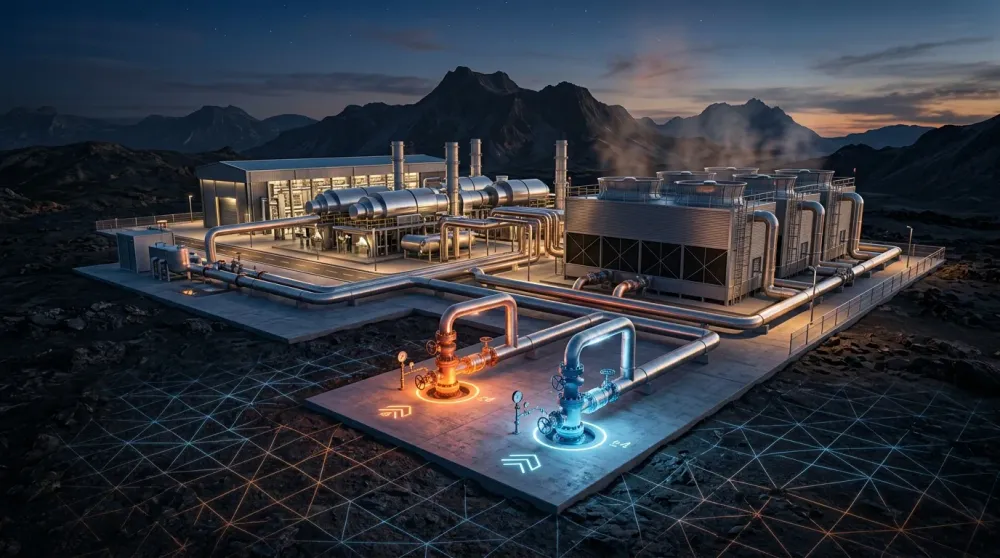
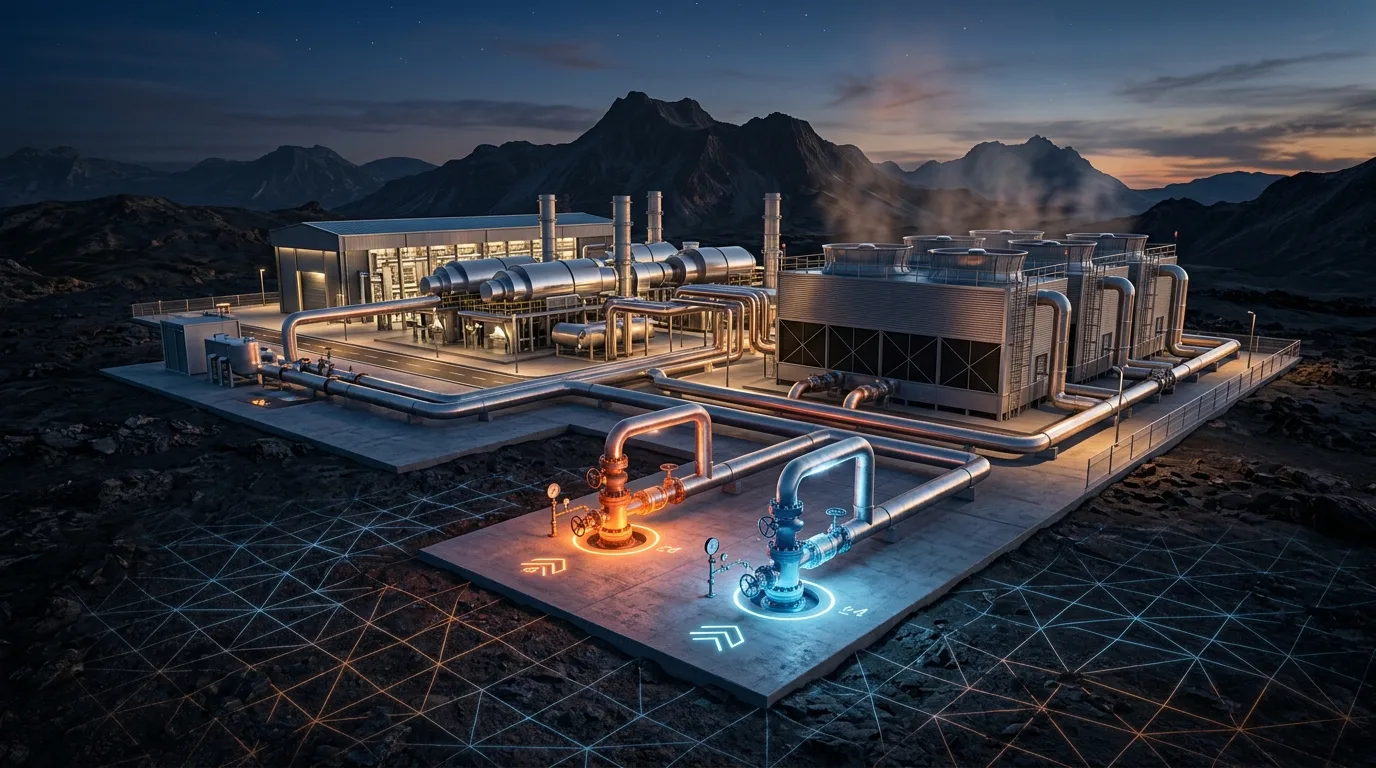
While subsurface engineering dominates EGS headlines, surface plant optimization is critical for capturing the extracted thermal energy with maximum efficiency. Because EGS targets often yield fluid temperatures between 150°C and 200°C—lower than traditional, high-enthalpy volcanic geothermal systems—flash steam plants are generally inappropriate. Instead, technoeconomic models assume the integration of binary cycle power plants, specifically Organic Rankine Cycle (ORC) systems.
In an ORC system, the produced geothermal brine never touches the turbine. It passes through a heat exchanger, transferring its thermal energy to a secondary working fluid (such as isobutane or specialized refrigerants) with a much lower boiling point. The vaporized working fluid expands through the turbine to generate electricity before being condensed and cycled back. Selecting the optimal working fluid based on the exact temperature of the subsurface brine is a major factor in plant efficiency.
Furthermore, ambient temperature plays a massive role in mechanical integration and OPEX. Air-cooled condensers are typically preferred in EGS deployments to conserve water, but they are highly sensitive to seasonal temperature swings. High summer temperatures degrade cooling efficiency, severely curtailing net power output when grid demand (and power pricing) is highest. Technoeconomic models must simulate hourly thermodynamic performance across seasonal variations to accurately project annual revenue generation and system LCOE.
Structuring Bankability, Tax Incentives, and Risk Allocation for Project Developers
Transitioning EGS from a theoretical resource to a commercial reality requires structuring projects to meet the stringent bankability requirements of project finance lenders. Commercial banks naturally shy away from subsurface uncertainty; they require guaranteed cash flows to service debt. Therefore, project developers must strategically allocate risk and leverage federal incentives to transform an EGS project into an attractive investment vehicle.
In the United States, recent policy shifts via the Inflation Reduction Act (IRA) have drastically improved EGS economics. Developers model the impact of the Investment Tax Credit (ITC) or the Production Tax Credit (PTC) directly into their cash flow waterfalls. A 30% to 50% ITC effectively slashes the upfront CAPEX burden of drilling, significantly lowering the LCOE and insulating equity investors from capital overruns. Offtake strategy is equally critical. By securing long-term, fixed-price Power Purchase Agreements (PPAs) that explicitly value the 24/7 nature of EGS baseload power, developers lock in the revenue side of the financial model.
To run custom Monte Carlo simulations and explore dynamic risk allocation models, analysts and developers can visit https://jisenergy.com/sign-up-login/ to access proprietary project finance tools. Ultimately, bankability is achieved when the probabilistic downside of subsurface performance is fully offset by tax equity investments, robust PPAs, and highly structured debt covenants.
Case Study: Technoeconomic Analysis of a Commercial Multi-Well EGS Pad
To synthesize these technoeconomic principles, consider a theoretical case study of a commercial-scale EGS deployment utilizing modern horizontal doublet architecture, akin to recent industry advancements in Nevada and Utah. The project entails drilling two injection and two production wells from a single surface pad, intersecting crystalline rock at 190°C.
CAPEX modeling estimates the four-well drilling and stimulation program at $60 million, capitalizing on rig-mobilization efficiencies and batch drilling. An additional $35 million is allocated to the ORC surface plant, transmission tie-in, and development soft costs, pushing total CAPEX to $95 million. Subsurface flow tests probabilistically validate a combined mass flow rate of 160 kg/s with a modeled thermal drawdown of just 1.5% annually.
Factoring in a 25% parasitic load for the electric submersible pumps, the multi-well pad yields a net generation of 15 MW. When applying a 30% ITC and modeling OPEX at $25/MWh (accounting for pump replacements over a 25-year asset life), the Monte Carlo P50 output yields an LCOE of roughly $65/MWh. At this price point, the EGS asset is highly competitive with natural gas peaking plants and battery-backed solar, definitively proving that economies of scale achieved through multi-well pad drilling can bridge the gap to commercial viability.
Conclusion: De-risking EGS for Scalable Commercial Deployment
The successful commercialization of Enhanced Geothermal Systems is no longer constrained by insurmountable physics; it is a challenge of iterative engineering, risk characterization, and financial optimization. As technoeconomic models grow more sophisticated, the path to grid-scale EGS deployment becomes clear. It requires relentlessly driving down drilling CAPEX through technological crossover from the oil and gas sector, mitigating operational parasitic loads, and accurately predicting subsurface thermal behavior over decades.
By applying rigorous probabilistic modeling and strategically utilizing structural tax incentives, project developers can present lenders with a risk profile that is acceptable for massive capital deployment. EGS offers a unique value proposition: a firm, dispatchable, geographically flexible, and zero-carbon energy source that perfectly complements the intermittent nature of renewables. As developers consistently prove they can execute multi-well strategies that yield an LCOE competitive with fossil baseload, next-generation EGS will rapidly transition from pilot projects into the scalable backbone of the future clean energy economy.