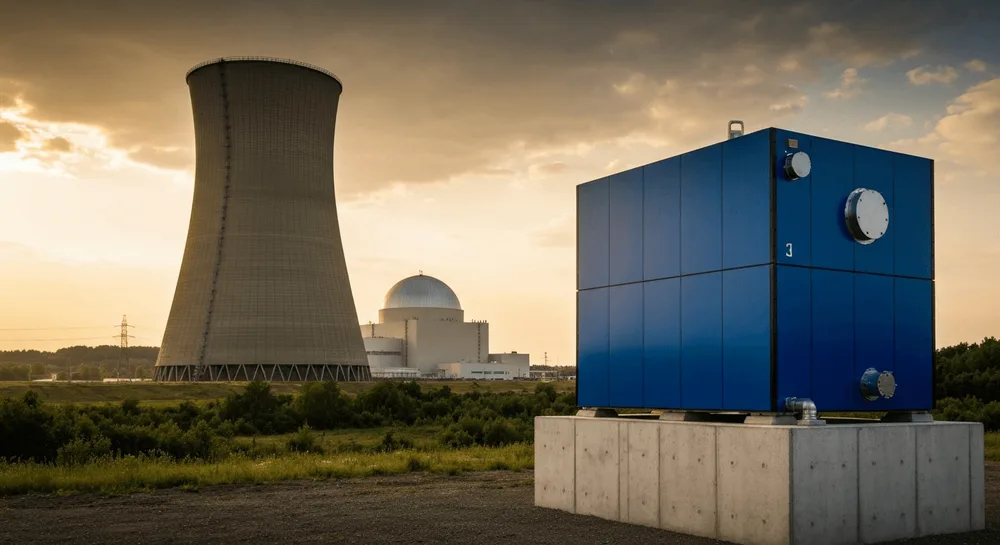
The Advanced Nuclear Trifecta: A Foundational Shift
STREAMLINED POLICY
NRC proposes its most consequential reactor licensing overhaul in a generation, aiming to modernize and accelerate the path for new builds.
SECURED FUEL
A $900M DOE contract moves the sole U.S. HALEU facility to commercial operation, unlocking the fuel supply chain for advanced reactors.
DE-RISKED FINANCE
DOE commits $17.5 billion in financing for long-lead equipment for a new fleet of Westinghouse AP1000 reactors.
The past week marked a pivotal moment for the future of nuclear power in the United States, with coordinated moves from regulators, financiers, and the fuel supply chain creating the most favorable development environment in decades. These actions collectively address longstanding barriers to new nuclear construction, signaling a clear federal intent to accelerate the deployment of both large-scale and advanced reactors. The convergence of these developments transforms the technoeconomic calculus for new nuclear projects, moving them from long-term ambitions to tangible, near-term investment opportunities.
The most significant structural change comes from the Nuclear Regulatory Commission (NRC), which proposed a 553-page rule to overhaul its reactor licensing framework. This landmark proposal aims to streamline everything from siting and construction to operation and decommissioning, bundling decades of proposed modernizations into a single, cohesive rule. For developers of advanced reactors, this reform promises to reduce the profound regulatory uncertainty and long timelines that have historically inflated project costs and deterred private investment. The new framework is specifically designed to accommodate innovative designs, providing a clearer, more predictable path to market.
This regulatory overhaul is powerfully complemented by major financial and supply chain commitments from the Department of Energy (DOE). The DOE announced a $17.5 billion conditional loan package to finance long-lead equipment for up to five new two-reactor projects using Westinghouse's AP1000 design. This funding directly de-risks the most capital-intensive phase of development, enabling utilities to procure critical components like reactor vessels and steam generators years in advance. According to the U.S. Energy Information Administration, managing upfront capital costs is crucial for the financial viability of such large-scale projects. Simultaneously, the DOE finalized a $900 million contract with Centrus Energy to transition the nation's only high-assay low-enriched uranium (HALEU) production facility to full commercial operation. As HALEU is the required fuel for most next-generation reactor designs, this move resolves a critical chicken-and-egg dilemma that has hampered the advanced nuclear sector.
These foundational shifts in policy, finance, and fuel are substantiated by tangible technological progress. This week, Deployable Energy’s Unity reactor achieved criticality at Idaho National Laboratory, becoming the third advanced reactor to do so under a recent DOE initiative. Further innovation was demonstrated by AMPERA's production of the first full-scale, 3D-printed nuclear reactor module. Together, these parallel advancements create a powerful momentum. The alignment of a modernized regulatory pathway, massive federal financial backing, and a secure advanced fuel supply chain represents a fundamental change in the U.S. energy landscape, positioning nuclear power for a significant role in meeting future carbon-free energy demand. More information on federal energy policy can be found at energy.gov.
This Week's Top 5 Energy News Items
- NRC Proposes Landmark Reactor Licensing Overhaul, Bundling Decades of Modernization Into One Rule
- DOE commits $17.5 billion to finance long-lead equipment for U.S. fleet of Westinghouse AP1000 reactors
- FERC takes historic action, orders US grid operators to ‘defend or revise’ large load interconnection tariffs
- Centrus Signs $900M DOE Contract, Pivots Sole U.S. HALEU Cascade to Commercial Operation
- Analysts expect rising PPA prices as clean energy tax credits phase out
For deeper technoeconomic analysis on this trend, try CogenS free.