Introduction: The Driving Forces Behind Data Center Cogeneration Economics
The hyperscale data center market is experiencing an unprecedented era of expansion, fueled by the relentless integration of artificial intelligence, machine learning, and cloud-native applications. However, this exponential digital growth has collided with a physical reality: macrogrid infrastructure is struggling to keep pace. Utility interconnection queues stretch for years, and grid congestion exposes mission-critical facilities to curtailment risks and volatile locational marginal pricing.
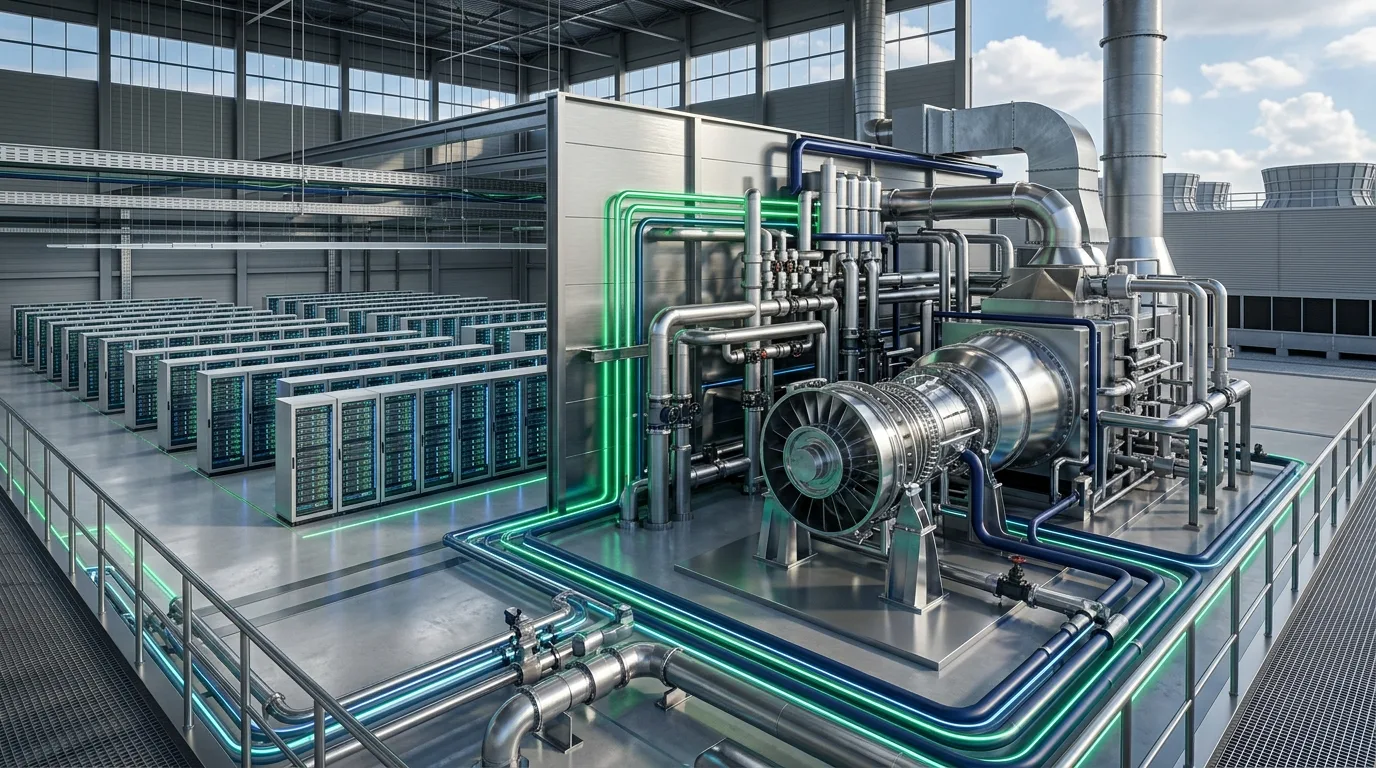
In response, hyperscalers and colocation providers are aggressively pursuing behind-the-meter generation strategies to seize control of their energy destiny. Gas-turbine cogeneration, or Combined Heat and Power (CHP), has emerged as the premier technoeconomic solution to bridge the gap between digital ambition and energy availability. By generating electricity onsite and capturing the exhaust heat to drive absorption cooling, hyperscalers can effectively bypass grid limitations. This decentralized approach fundamentally alters the traditional data center cost structure. Instead of acting as passive utility ratepayers, operators become active energy asset managers, leveraging natural gas infrastructure to achieve unparalleled scalability, operational autonomy, and long-term cost predictability.
The Hyperscale Energy Challenge and Power Usage Effectiveness (PUE)
Data centers are among the most energy-intensive commercial infrastructures on the planet. A modern 100 MW hyperscale facility requires power densities that frequently exceed 50 kW per rack to support advanced GPU clusters. This immense electrical draw generates an equally formidable thermal byproduct. Effectively managing this heat defines a facility's Power Usage Effectiveness (PUE), the ratio of total facility power consumed to the power consumed strictly by IT equipment.
According to federal efficiency models, lowering PUE is the most impactful way to reduce a data center's total cost of ownership (Source: energy.gov). Historically, traditional mechanical chillers running on grid electricity have been the primary culprit for inflating PUE, often accounting for 30-40% of the non-IT load. As densities scale, the parasitic electrical load required for legacy vapor-compression cooling threatens to cannibalize the power envelope intended for revenue-generating servers. This compounding energy challenge demands a paradigm shift in facility engineering, forcing operators to look beyond grid electricity and embrace thermodynamic systems that can simultaneously address high-density electrical baseloads and intensive space-cooling requirements.
Thermodynamic Synergies of Gas-Turbine CHP in Mission-Critical Facilities
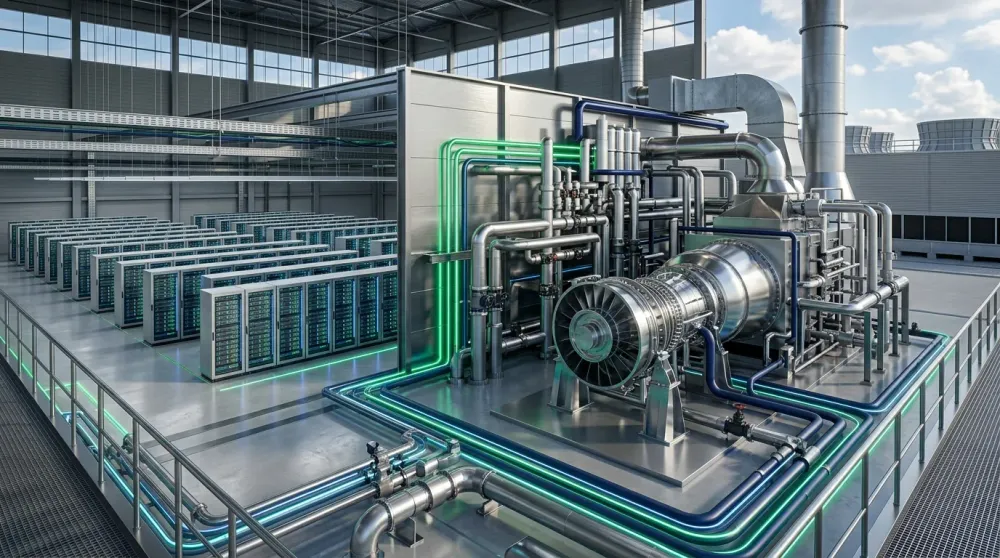
The integration of gas-turbine cogeneration transforms a data center from a simple consumer of electricity into an integrated thermodynamic ecosystem. At its core, a gas turbine operates on the Brayton cycle, combusting natural gas to spin a generator and produce primary electrical power. The fundamental inefficiency of open-cycle gas turbines is the tremendous volume of high-grade thermal energy exhausted into the atmosphere—often representing 60% of the fuel's initial energy content.
In a mission-critical CHP deployment, a Heat Recovery Steam Generator (HRSG) or an exhaust gas heat exchanger captures this thermal plume. Because hyperscale data centers exhibit nearly flat 24/7/365 electrical demand and corresponding, relentless cooling loads, they present the perfect operational profile for cogeneration. There is no diurnal fluctuation to strand thermal assets; every megawatt of power generated yields a proportional, predictable volume of heat. By capturing and redirecting this otherwise wasted thermal energy to perform useful work within the facility, overall thermodynamic efficiencies can skyrocket from grid averages of 35-40% to staggering overall plant efficiencies exceeding 80%.
Matching Electrical Baseloads with Absorption Cooling Demand
The ultimate technoeconomic triumph of data center CHP lies in the elegant matching of electrical generation with absorption cooling. Absorption chillers utilize the captured exhaust heat from the gas turbines to drive a thermochemical compression cycle—typically utilizing a lithium bromide and water solution—thereby producing chilled water without the need for mechanical compressors.
This thermal coupling creates a powerful feedback loop of efficiency. By shifting the cooling burden from electrically driven centrifugal chillers to heat-driven absorption chillers, the facility radically reduces its parasitic electrical demand. Consequently, a higher percentage of the turbine’s electrical output can be dedicated directly to the IT servers. Sizing the prime movers requires meticulous modeling to ensure the thermal-to-electric ratio of the turbine aligns with the facility’s chilling ton requirements. When expertly engineered, this thermal baseload matching effectively eliminates the most volatile and expensive component of traditional data center operations, cementing an ultra-low PUE while maximizing the economic yield of every MMBtu of natural gas consumed.
Capital Expenditure (CAPEX) Breakdown for Gas-Turbine CHP Systems
Transitioning to onsite power generation requires a substantial upfront capital expenditure (CAPEX), necessitating rigorous financial underwriting. For a utility-scale hyperscale deployment—often ranging from 30 MW to 100 MW—the capital outlay involves complex mechanical, electrical, and structural systems. Technoeconomic analysis demands categorizing these costs to accurately model depreciation schedules and capital allocation.
The primary CAPEX buckets include the prime movers (gas turbines) and electrical generators, which generally constitute the largest portion of hardware costs. This is closely followed by the thermal energy recovery equipment (HRSGs and absorption chillers). The third major segment is the Balance of Plant (BOP), which encompasses fuel gas compressors, structural steel, cooling towers, piping networks, and emissions control systems like Selective Catalytic Reduction (SCR) units. Finally, electrical integration—comprising paralleling switchgear, step-up transformers, and protective relays—alongside the engineering, procurement, and construction (EPC) fees, completes the financial picture. Accurately modeling this CAPEX baseline is the foundational step in determining the facility's eventual levelized cost of energy (LCOE) and long-term project viability.
Prime Mover, Generator, and Heat Recovery Steam Generator (HRSG) Costs
The core of the CHP investment centers on the procurement of the gas turbine, the synchronous generator, and the HRSG. In hyperscale applications, operators typically select aeroderivative gas turbines due to their rapid start capabilities, high cycle efficiencies, and exceptional load-following characteristics. These units carry a premium over heavier frame turbines, often pricing between $600 and $900 per kilowatt of capacity, depending on the current commodity environment and OEM backlog.
The generator must be precision-matched to the turbine shaft output and engineered to handle the severe harmonic profiles characteristic of modern server power supplies. Meanwhile, the HRSG represents a significant metallurgical investment. Depending on whether the facility requires high-pressure steam for double-effect chillers or lower-grade hot water, the HRSG must be fabricated from specialized alloys capable of withstanding constant thermal cycling and corrosive exhaust environments. Together, this tri-part assembly of turbine, generator, and HRSG dictates both the total electrical yield and the maximum available thermal offset, making their selection the single most critical engineering and financial decision of the project.
(from HRSG)
(Data Hall)
Absorption Chiller Integration and Balance of Plant (BOP) Requirements
Integrating absorption chillers involves complex hydronic and mechanical engineering, significantly impacting the Balance of Plant (BOP) costs. Hyperscale facilities often deploy double-effect or even triple-effect lithium bromide absorption chillers to maximize the coefficient of performance (COP). These high-efficiency units command a capital premium and require elaborate piping networks constructed of corrosion-resistant materials to transport the high-temperature steam or water from the HRSG.
Beyond the chillers themselves, the BOP must support the expanded thermal loop. This includes extensive cooling tower arrays necessary to reject the latent heat generated during the absorption cycle. Additionally, specialized variable frequency drive (VFD) pumps, robust heat exchangers, and sophisticated digital control systems (DCS) are required to orchestrate the delicate balance between thermal supply and the data hall's real-time cooling demands. This mechanical integration represents a significant portion of project complexity, requiring spatial planning within the facility footprint to accommodate the large physical dimensions of commercial absorption equipment.
Electrical Switchgear, Grid Interconnection, and EPC Contracting Fees
While the mechanical systems are the heart of a CHP plant, the electrical switchgear acts as the nervous system, enabling the seamless integration of onsite generation with the utility grid. Capital must be allocated for heavy-duty paralleling switchgear, synchronization controllers, step-up transformers, and protective relay panels capable of instantaneous fault detection. These systems ensure that the plant can operate in parallel with the grid or safely decouple during a utility disturbance.
Executing a project of this magnitude requires a highly specialized Engineering, Procurement, and Construction (EPC) firm. EPC wrap contracts guarantee schedule and performance, but they introduce a markup that typically ranges from 15% to 25% of the total hard costs. This EPC fee covers detailed engineering design, permitting, site preparation, construction labor, and the rigorous commissioning processes mandated by Tier III or Tier IV data center certifications. While expensive, a reputable EPC mitigates project execution risk, a critical factor for hyperscalers relying on strict deployment timelines.
Operational Expenditure (OPEX) and Fuel Dynamics
The transition from grid reliance to onsite cogeneration fundamentally shifts a data center's financial profile from OPEX-heavy utility payments to a blend of debt service on CAPEX and highly specific variable OPEX. In a gas-turbine CHP facility, natural gas procurement is the dominant operational expenditure, frequently constituting 70% to 80% of total lifetime OPEX.
Because fuel costs heavily outweigh routine maintenance and labor, the technoeconomics are exquisitely sensitive to turbine heat rates (efficiency) and the macro-dynamics of natural gas markets. Even marginal degradation in compressor efficiency over time can result in substantial fuel cost penalties. Therefore, modeling OPEX requires factoring in ambient temperature variations—as gas turbines lose efficiency and output in high heat—alongside parasitic facility loads. Additionally, operators must account for fixed OPEX components, including specialized operational personnel, site security, water consumption for cooling towers, and emissions monitoring software required for environmental compliance.
Interconnect
Contracts
Hedging (NYMEX)
Natural Gas Procurement Strategies and Pipeline Infrastructure
Because mission-critical data centers cannot tolerate interruptions, the physical and financial procurement of natural gas must be derisked meticulously. Physically, facilities must secure "firm" transportation contracts on interstate pipelines, guaranteeing fuel delivery even during winter peaking events when residential heating demand threatens regional supply lines. If a site lacks direct proximity to high-pressure trunk lines, the capital costs of laying laterals and installing gas booster compressors must be absorbed into the project economics.
Financially, exposure to spot market volatility is an unacceptable risk for hyperscale operators requiring cost predictability. Advanced energy procurement strategies involve locking in long-term commodity hedges through the NYMEX Henry Hub futures market, utilizing swaps, options, and basis contracts. By blending spot purchases with strategic, laddered forward contracts, developers synthesize a predictable blended fuel price. This sophisticated financial engineering shields the facility’s operating margin from macroeconomic shocks and geopolitical supply disruptions.
Long-Term Service Agreements (LTSA) and Turbine Maintenance Cycling
Gas turbines are highly sophisticated thermodynamic machines operating at extreme temperatures and rotational speeds, necessitating rigid maintenance schedules. To guarantee uptime and stabilize maintenance OPEX, hyperscalers universally execute Long-Term Service Agreements (LTSAs) with the original equipment manufacturers (OEMs) or specialized independent service providers.
These contracts shift the financial and operational risk of major unforced outages onto the service provider. An LTSA dictates a formalized maintenance cycle based on operating hours or equivalent starts. This lifecycle typically progresses from routine borescope inspections, through combustion section evaluations, to the highly intensive "Hot Gas Path" inspections where turbine blades and nozzles are replaced. Eventually, a major overhaul requires near-complete disassembly. By amortizing the massive costs of these overhauls into fixed monthly or hourly rates, operators transform unpredictable maintenance spikes into smooth, predictable OPEX line items that easily integrate into the facility's technoeconomic model.
Analyzing the Spark Spread and Thermal Offset in Data Center Cogeneration Economics
The primary metric governing the financial viability of any cogeneration project is the "spark spread." This refers to the theoretical gross margin of a gas-fired power plant, calculated by taking the cost of grid electricity and subtracting the cost of natural gas required to generate that same unit of power (Source: eia.gov). A wider spark spread indicates a more favorable environment for onsite generation.
However, standard spark spread calculations vastly underestimate data center CHP economics because they ignore the thermal offset. In a cogeneration setup, the recovered heat displaces the electricity that would have been required to run mechanical chillers. This avoided cooling cost must be credited back into the financial model, creating an "effective" spark spread that is significantly wider than that of a simple-cycle peaking plant. Regions characterized by high utility tariffs and robust, low-cost natural gas basins present the ultimate technoeconomic conditions, allowing hyperscalers to drastically undercut local grid energy rates while self-generating their cooling baseloads.
CAPEX, Gas Price, Grid Rates
Simulation
NPV, LCOE, IRR
Technoeconomic Modeling and Financial Performance Metrics
Developing a bankable CHP project requires graduating from back-of-the-napkin spark spread estimates to rigorous technoeconomic modeling. This involves creating sophisticated financial software models that synthesize hourly facility load profiles, ambient weather data, thermodynamic equipment performance, and volatile commodity pricing into a cohesive 20-year projection.
Because deterministic models—which rely on static assumptions—fail to capture real-world market volatility, experts employ probabilistic methods like Monte Carlo simulations. These models run thousands of scenarios, randomizing variables like winter gas spikes or unexpected LTSA maintenance delays within defined probability distributions. The outputs generate a statistical confidence interval for key financial performance metrics, ensuring project developers can guarantee board members or institutional investors a highly resilient financial return. This level of granular technoeconomic synthesis is what separates a conceptual engineering design from a fully funded, shovel-ready energy asset.
Discounted Cash Flow (DCF) Analysis for Hyperscale CHP Projects
The cornerstone of CHP project valuation is the Discounted Cash Flow (DCF) analysis. A gas turbine represents a long-term capital asset with a useful life extending 15 to 25 years. Because the value of a dollar saved in year ten is significantly less than a dollar held today, DCF methodologies apply a discount rate—typically the Weighted Average Cost of Capital (WACC) of the hyperscale entity—to future cash flows.
In a CHP model, cash flows are calculated not as revenue, but as "avoided costs." The model totals the projected costs of running a traditional grid-connected facility (grid electricity, capacity charges, transmission fees) and subtracts the projected costs of the CHP facility (CAPEX debt service, gas procurement, LTSA). The resulting net savings for each year are discounted back to their present value. A robust DCF analysis validates whether the massive upfront CAPEX is justified by the cumulative, time-adjusted operational savings over the lifespan of the data center.
Establishing Internal Rate of Return (IRR) and Net Present Value (NPV) Targets
For C-suite executives at colocation firms or hyperscalers, the decision to greenlight a megawatt-scale cogeneration project boils down to two metrics: Internal Rate of Return (IRR) and Net Present Value (NPV). NPV represents the absolute dollar value the project adds to the company after clearing the WACC threshold; a positive NPV indicates a financially accretive project.
IRR, conversely, calculates the annualized percentage yield of the invested capital. Energy infrastructure requires competing for internal capital against core business initiatives, like purchasing new server racks or acquiring real estate. Therefore, CHP projects must typically clear strict corporate hurdle rates. While a grid-tied utility might accept a 7% IRR for a power plant, aggressive tech companies often demand an unlevered IRR between 12% and 18% to justify the deviation from their core competency. Carefully architected CHP systems in high-tariff utility territories consistently clear these elevated hurdles.
Conducting Sensitivity Analysis on Fuel Volatility and Utility Rate Escalation
No technoeconomic model is complete without a rigorous sensitivity analysis. This process stress-tests the financial outputs against macro-level shocks to answer "what if" scenarios. Using tornado charts, analysts can visually identify which variables exert the most gravitational pull on the project's NPV.
Typically, natural gas prices and utility grid rate escalations form the widest bars on these charts. If a regulatory mandate forces the local utility to heavily escalate power tariffs to fund grid modernization, the CHP project's NPV balloons positively. Conversely, an unhedged spike in natural gas prices can rapidly erode margins. Stress-testing ensures that even in conservative scenarios—where gas prices drift higher and utility rate growth stagnates—the cogeneration plant remains economically viable and does not become a stranded asset on the hyperscaler's balance sheet.
Reliability, Resiliency, and Grid Interaction Value
While compelling ROI and IRR figures dominate board presentations, the intrinsic value of cogeneration for hyperscalers is heavily rooted in reliability and resiliency. The macrogrid is increasingly susceptible to severe weather events, rolling blackouts driven by capacity shortfalls, and aging transmission infrastructure. For facilities housing billions of dollars in critical data and compute infrastructure, relying solely on an unstable grid is an untenable risk.
Gas-turbine CHP transforms a vulnerable data center into a sovereign energy fortress. The continuous, baseload nature of a turbine provides a remarkably stable voltage and frequency profile, free from the sags and transients inherent in grid power. By generating prime power behind the meter, the facility inherently bypasses macrogrid vulnerability, relying instead on underground natural gas pipeline networks, which boast statistically superior reliability metrics compared to overhead electrical transmission lines during catastrophic weather events.
$9,000 / Minute
via CHP
Added to NPV
Monetizing Uptime and Quantifying the Cost of Hyperscale Downtime
The financial modeling of a CHP system is not strictly limited to utility savings; it must encompass the avoidance of catastrophic losses. In the colocation and hyperscale sector, Service Level Agreements (SLAs) guarantee extreme uptime standards. Failing to meet these SLAs due to a grid outage triggers severe financial penalties, client attrition, and massive brand damage.
Industry analyses demonstrate that the cost of unplanned data center outages routinely exceeds $9,000 per minute, with major incidents costing operators tens of millions of dollars (Source: uptimeinstitute.com). When a technoeconomic model attributes a probabilistic financial value to this avoided downtime risk, the NPV of a CHP project escalates dramatically. The cogeneration plant ceases to be merely an energy-saving asset and transforms into a vital operational insurance policy, monetizing the guarantee of "five nines" (99.999%) availability in an increasingly unstable grid environment.
Detected
(Islanding)
Load Solo
Microgrid Integration, Island-Mode Transition, and Black Start Capabilities
A standalone generator does not equal a resilient facility; it requires sophisticated microgrid controls. When a utility disturbance occurs, the data center must execute an instantaneous "island-mode" transition. Highly responsive microgrid controllers sense frequency or voltage anomalies and immediately open the main utility breakers, physically severing the facility from the collapsing macrogrid (Source: nrel.gov).
During this split-second transition, the gas turbines must dynamically adjust to carry the facility's entire load without tripping. For ultimate resilience, the system must also feature "black start" capabilities. If the entire plant shuts down, a black start system—often comprising a small diesel generator or a Battery Energy Storage System (BESS)—provides the initial excitation current to spin the gas turbine compressors and reignite the combustion process independently of the grid. This autonomous recovery capability is a mandatory engineering requirement for Tier IV data center topologies.
Ancillary Services Revenue and Grid Export Opportunities
Beyond operational savings, a grid-paralleled CHP facility can act as a revenue-generating profit center by participating in wholesale electricity markets. Because hyperscale generation assets are substantial—often rivaling small utility plants—they can enroll in grid operator (ISO/RTO) programs to provide ancillary services.
By reserving a margin of turbine capacity, operators can sell frequency regulation, spinning reserves, or demand response services back to the grid. Furthermore, during peak summer hours when locational marginal pricing (LMP) spikes to astronomical levels, the facility can purposefully over-generate and export surplus megawatts onto the grid. This bi-directional energy flow creates lucrative new revenue streams that actively aggressively buy down the project's CAPEX. A finely tuned technoeconomic model assesses regional market structures (like PJM or ERCOT) to forecast these potential ancillary revenues, further enhancing the project's overall financial allure.
Mech Cooling
Environmental Economics, Carbon Compliance, and Future-Proofing
Despite natural gas being a fossil fuel, high-efficiency cogeneration often represents a net-positive environmental step for hyperscalers operating in fossil-heavy utility territories. Achieving 80% thermodynamic efficiency means drastically less fuel is combusted per unit of useful energy compared to traditional grid power.
However, tech giants operate under stringent ESG (Environmental, Social, and Governance) mandates and ambitious net-zero pledges. Consequently, the technoeconomic analysis must justify natural gas assets within a decarbonization framework. The economics must account for the installation of advanced emissions control technologies, such as Selective Catalytic Reduction (SCR) to eliminate Nitrogen Oxides (NOx) and oxidation catalysts for Carbon Monoxide (CO). Future-proofing the asset involves evaluating the initial CAPEX premium against the long-term risk of regulatory obsolescence, ensuring the facility meets all local air permitting standards while serving as a bridge technology toward a fully renewable future.
(Tax or Trading)
Cost OPEX
Carbon Pricing, Emissions Trading, and Impacts on Lifetime OPEX
Environmental regulations are increasingly translating into direct financial liabilities through carbon pricing mechanisms. Depending on the jurisdiction, a CHP facility may be subject to cap-and-trade programs (such as the Regional Greenhouse Gas Initiative, RGGI) or explicit carbon taxes.
These regulatory frameworks mandate the purchase of carbon allowances for every metric ton of CO2 emitted. A comprehensive technoeconomic model must apply a "shadow price" to carbon over the 20-year lifecycle of the asset, forecasting the escalating costs of these allowances. If carbon taxes rise too aggressively, the operational OPEX of the gas turbine will inflate, potentially compressing the project's IRR. Conversely, because CHP uses fuel more efficiently than the baseline grid, operators may actually generate tradeable carbon credits if their emissions fall below mandated regional baselines, turning a regulatory risk into a financial asset.
Hydrogen Blending Capabilities and the Path to Net-Zero Gas Turbines
To reconcile multi-decade gas turbine investments with 2030 and 2040 net-zero targets, hyperscalers are demanding next-generation turbine hardware. OEMs are responding by outfitting aeroderivative and frame turbines with Dry Low Emissions (DLE) combustors engineered to handle hydrogen (H2) blending.
Hydrogen combusts with zero CO2 emissions, offering a credible pathway to decarbonize thermal power. Currently, many advanced turbines can safely fire a blend of up to 30% hydrogen by volume with natural gas without requiring significant hardware modifications. While green hydrogen is currently economically prohibitive as a baseload fuel, specifying H2-capable equipment today preserves the asset's viability. As regional hydrogen hubs mature and fuel pipelines adapt, the CHP facility can progressively dial up its hydrogen mix, steadily diluting its carbon footprint and securing its place in a net-zero future without stranded capital.
(Post-Chiller)
(Municipal/Agri)
Monetizing Excess Waste Heat via District Energy Networks
In regions with cold climates, particularly Northern Europe and parts of North America, data centers generate far more low-grade heat than is required for their internal operations. Historically, this energy was wasted, rejected into the atmosphere via cooling towers.
Advanced technoeconomic strategies transform this liability into an asset through district energy integration. By installing heat exchangers, hyperscalers can export excess hot water to municipal district heating networks, nearby commercial developments, or industrial greenhouses. Not only does this generate a secondary revenue stream by selling thermal energy at a fixed rate per MMBtu, but it dramatically elevates the holistic efficiency of the facility. Partnering with municipalities to provide clean, reliable heat fosters immense public goodwill, expedites difficult zoning approvals, and positions the data center as a vital, integrated component of the local civic infrastructure.
Case Study: Technoeconomic Assessment of a 50 MW Hyperscale CHP Facility
To crystalize the theory, consider a hypothetical technoeconomic assessment of a 50 MW hyperscale facility located in the PJM interconnect (Mid-Atlantic USA). The local utility faces transmission bottlenecks, quoting a three-year interconnection delay and an all-in power tariff of $0.12 per kWh. Conversely, the facility sits near highly productive shale gas infrastructure, securing a long-term gas hedge at a highly competitive $3.50 per MMBtu.
This scenario represents an exceptional effective spark spread. The facility requires 50 MW of clean, uninterrupted electrical power for its servers, alongside approximately 12,000 tons of baseload cooling. Operating on the grid, annual power expenditures would easily exceed $50 million, while leaving the facility entirely exposed to grid unreliability and seasonal rate hikes. The developer opts to conduct a feasibility study on a fully islandable cogeneration plant to eliminate interconnection delays and secure a fixed cost of computing.
20 MW
20 MW
20 MW
Standby
Facility Load Profile Matching and Technology Selection
Designing the system requires strict adherence to N+1 redundancy. For a 50 MW continuous load, the engineering firm selects a configuration of three active 20 MW aeroderivative gas turbines (totaling 60 MW for overhead), plus one 20 MW unit resting in cold standby to satisfy the N+1 mandate.
Each active turbine is paired with an HRSG that captures roughly 75,000 lbs/hr of steam. This thermal output is directed into a centralized plant of double-effect absorption chillers, perfectly matching the 12,000-ton chilling requirement without tapping mechanical compressors. A localized microgrid controller links the synchronous generators. Should one active unit trip, the control system instantaneously throttles up the remaining units while simultaneously auto-starting the N+1 turbine, ensuring zero disruption to the data hall's critical bus.
Financial Modeling Results, Payback Period, and Ten-Year ROI Evaluation
Running this 50 MW hardware configuration through a 20-year probabilistic DCF model yields compelling technoeconomic justification. Despite a daunting initial CAPEX approaching $120 million (inclusive of prime movers, BOP, chillers, and EPC margins), the effective spark spread generates immense annual operating cash flow compared to the grid baseline.
The model calculates roughly $25 million in avoided electrical costs annually, netted against the $8 million in fixed/variable gas procurement and LTSA fees. This results in a simple payback period of approximately 4.2 years. Evaluating the project on a 10-year horizon, the unlevered IRR clears 18.5%, solidly beating the hyperscaler’s 15% hurdle rate. Furthermore, when factoring in the probabilistic avoided cost of just one major grid-induced downtime event over the decade, the Net Present Value balloons, proving definitively that the facility is highly profitable strictly on an energy-arbitrage basis.
ROI
Uptime
Bypass
Conclusion: Strategic Implementation of CHP for Hyperscale Resiliency
In an era where digital expansion is bottlenecked by physical infrastructure constraints, continuing to rely entirely on utility-supplied power represents an existential risk to hyperscale operators. Gas-turbine cogeneration fundamentally flips the script. It is no longer just an energy efficiency play; it is a strategic maneuver to secure energy sovereignty.
By embracing CHP, data centers can deploy capacity on their own timelines, impervious to grid interconnection queues. The thermodynamic synergies of matching baseload power generation with absorption cooling drive PUE to its absolute theoretical limits, unlocking profound economic margins. When meticulously modeled, the combination of wide effective spark spreads, robust microgrid resiliency, and hydrogen-ready future-proofing ensures that cogeneration assets remain financially accretive for decades. The technoeconomic verdict is clear: behind-the-meter CHP is the paramount infrastructure strategy for bridging the gap between grid limitations and the relentless demand of the digital economy.
Next Steps for Project Developers, ESCOs, and Engineering Firms
Transforming a conceptual CHP strategy into an operational hyperscale asset requires assembling a specialized coalition of engineering firms, Energy Service Companies (ESCOs), and project developers. The first critical step is initiating a comprehensive, site-specific feasibility study. This study must synthesize regional gas tariffs, utility interconnection policies, and high-fidelity thermal load modeling to validate the preliminary economics.
Developers must then engage with turbine OEMs to secure production slots, as supply chain lead times can dictate deployment schedules. Simultaneously, financial teams should finalize the Monte Carlo risk models and begin structuring the capital stack. For stakeholders ready to transition from passive power consumers to active energy managers, leveraging specialized expertise is mandatory. To access advanced technoeconomic modeling tools and connect with industry-leading energy procurement strategies, developers are encouraged to visit JIS Energy and begin architecting their path to hyperscale energy independence.