Enhanced Geothermal Commercialization
Fervo's Cape Station validates EGS tech at utility scale.
DOE funding injection for exploration and field-scale testing.
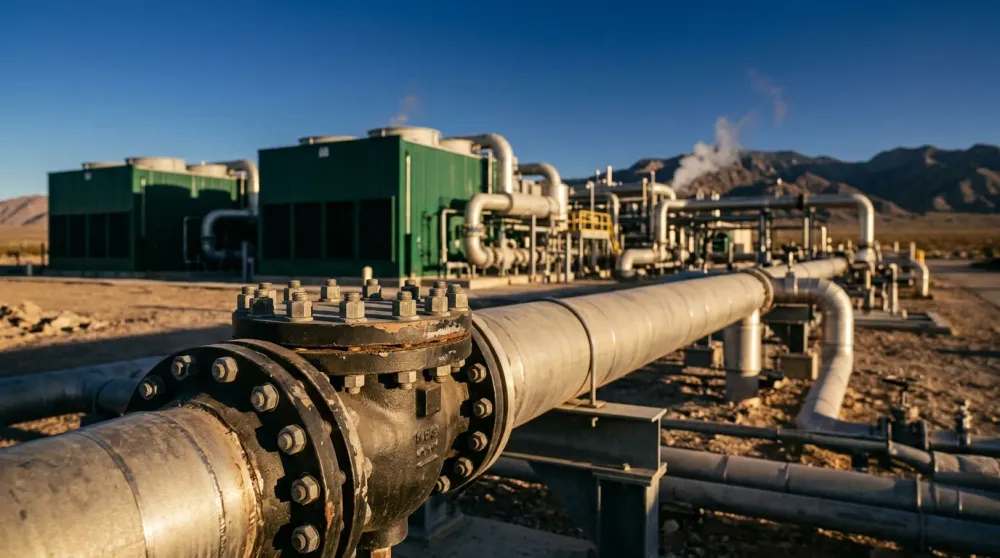
Enhanced geothermal systems (EGS) crossed a critical commercial threshold this week. Fervo Energy successfully achieved first power at its Cape Station project in Beaver County, Utah. The milestone validates the application of horizontal drilling and multi-stage hydraulic fracturing techniques to crystalline rock formations, producing firm, dispatchable heat for power generation.
The engineering data emerging from Cape Station provides hard numbers on flow rates, thermal drawdown, and parasitic pumping loads. Developers previously relied on modeled assumptions to project the levelized cost of energy (LCOE) for deep EGS projects. Continuous operational data will now inform the financial models required to secure competitive project finance terms. By adapting oil and gas drilling technology, the sector has substantially reduced subsurface risk, turning a geological unknown into a predictable manufacturing process.
The federal government is simultaneously injecting capital to accelerate this technical momentum. The U.S. Department of Energy announced $99 million in funding targeted at next-generation geothermal field-scale tests and exploration drilling. This funding mechanism directly attacks the steep upfront capital requirements of exploratory wells, improving the internal rate of return (IRR) for early movers. You can review the specifics of nationwide geothermal resource estimates through the National Renewable Energy Laboratory.
Adding gigawatts of firm, high-capacity-factor generation alters regional grid capacity expansion models. As variable renewable penetration increases, system operators require extended duration balancing resources. Dispatchable geothermal power minimizes the required duration and capacity of co-located battery energy storage systems (BESS). When load-serving entities procure baseload geothermal, the residual ramping requirements assigned to storage and peaking assets drop sharply.
This technical progression arrives precisely as data centers and industrial electrification drive unprecedented load growth. Utilities are searching for zero-carbon generation that can run around the clock regardless of weather conditions. EGS technology provides a geographic flexibility that traditional hydrothermal resources lack, opening entirely new regions to development. The latest energy projections from the U.S. Energy Information Administration point to sustained demand growth that requires diverse, firm generation fleets.
Financial institutions will closely monitor the operational metrics from Cape Station over the coming months. Sustained thermal output without excessive pressure decline will prove that engineered reservoirs can deliver steady cash flows over a 30-year operational life. Turbine selection and organic Rankine cycle efficiency optimizations will command significant engineering attention in the next phase of plant design.
This Week's Top 5 Energy News Items
- Fervo Energy achieves first power at flagship Utah geothermal project
- DOE targets next-gen geothermal development with $99M for field-scale tests, exploration drilling
- Advanced transmission projects get $1.9B in DOE funding
- Australia’s most powerful battery finally completed after lengthy delays
- Google to pay for nuclear uprates at Georgia Power’s Hatch, Vogtle plants
For deeper technoeconomic analysis on this trend, try CogenS free.