
BTM Generation Capacity Surge: Data Center Power (2026-2030)
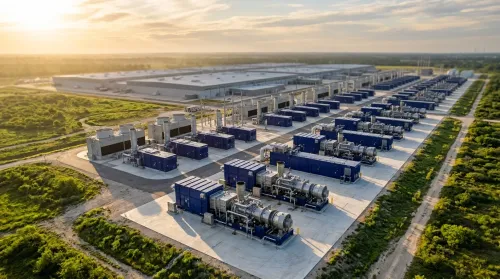
Bloom & Brookfield
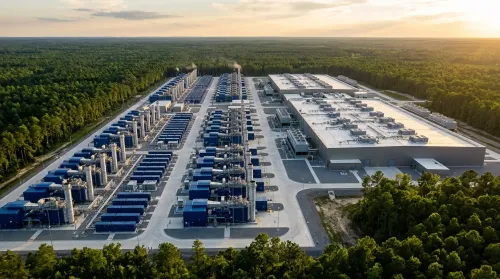
Black Hills Microgrid
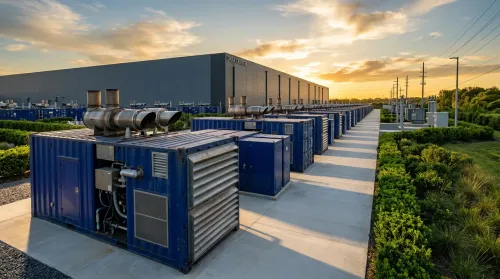
Baker Hughes & Kodiak
Source: Q4 2026 Industry Announcements
Data center developers are increasingly skipping utility interconnection queues in favor of gigawatt-scale behind-the-meter (BTM) microgrids. The capital flows announced this week indicate a major move toward localized natural gas and fuel cell generation, often bypassing traditional transmission constraints.
In Wyoming, Black Hills Corp. is advancing a $1.8 billion natural gas generation plan and will manage a 2.1-GW microgrid for a planned Google data center in Cheyenne. The scale of this single BTM deployment rivals the peak load of mid-sized regional utilities. Meanwhile, Bloom Energy and Brookfield scaled their existing financing partnership from $5 billion to $25 billion to deploy solid oxide fuel cells at AI infrastructure sites globally.
Equipment manufacturers are scaling production to meet this demand curve. Baker Hughes formalized an agreement with Kodiak Gas Services to supply gas turbines supporting up to 1.8 GW of BTM capacity by 2030. In Texas, Cummins finalized a deal to supply natural gas generator sets for Circe Energy’s high-performance computing microgrid, with deliveries running through the end of the decade. As diesel backup systems increasingly trigger stringent air permitting requirements under environmental law, developers are heavily weighting continuous-duty natural gas engines, turbines, and large-scale battery energy storage systems (BESS) as primary power nodes. The U.S. Energy Information Administration's latest Electric Power Monthly data confirms utility-scale net generation is increasing, but these massive isolated loads demand deployment timelines utilities often struggle to guarantee.
State-level political pushback compounds the utility delay. Voters in multiple localities chose to limit or outright ban data center development when the option was on the ballot during the recent midterm elections. By internalizing power generation, hyperscalers reduce their exposure to utility rate cases and public transmission planning disputes. As highlighted by researchers at the National Renewable Energy Laboratory, well-designed microgrids offer enhanced operational resilience while isolating the broader macrogrid from abrupt localized demand spikes.
These BTM assets demand precise techno-economic optimization. A 2.1-GW microgrid requires continuous load balancing, complex thermal management, and dynamic financial dispatch models to justify the initial capital expenditure against the avoided cost of utility delays.
This Week's Top 5 Energy News Items
- Black Hills to build 564 MW of new gas, manage 2.1 GW microgrid for Google data center in Wyoming
- Brookfield, Bloom Energy expand partnership to $25 billion framework for onsite data center power
- Baker Hughes gas turbines to support up to 1.8 GW of behind-the-meter data center power
- Voters gave a big middle finger to data centers
- Cummins to provide gas generators for Texas data center microgrid
For deeper technoeconomic analysis on this trend, try CogenS free.