Introduction: The Inevitable Shift to Geothermal Exchange in Commercial Buildings
Market Drivers
Decarbonization Mandates, ESG Reporting, and Electrification Goals are compelling asset owners to seek high-performance, fossil-fuel-free HVAC solutions.
Technology Pull
Geothermal exchange offers unmatched efficiency (40-70% less energy than conventional HVAC), operational stability, and a 50+ year infrastructure lifespan, de-risking long-term ownership.
The commercial real estate sector stands at a pivotal juncture, confronted by a confluence of regulatory pressures, volatile energy markets, and escalating stakeholder demands for environmental, social, and governance (ESG) performance. In this new paradigm, conventional HVAC systems—reliant on fossil fuels and refrigerant-based air-to-air heat exchange—represent a growing liability. The strategic migration toward geothermal exchange, also known as ground source heat pump (GSHP) systems, is no longer a niche consideration but an emerging strategic imperative. This shift is driven by the technology's inherent ability to use the earth's stable subsurface temperature to provide highly efficient, all-electric heating and cooling. As building performance standards tighten and electrification becomes the default pathway to decarbonization, geothermal exchange offers a robust, scalable, and future-proof solution that transforms a building's largest energy consumer into a high-performance, resilient asset. This analysis provides a comprehensive framework for understanding and evaluating this transformative technology.
The Core Value Proposition: Moving Beyond Volatile Energy Costs and Decarbonization Mandates
Financial Resilience
Decouples building OpEx from volatile fossil fuel and electricity spot markets.
Operational Superiority
Eliminates outdoor equipment, reducing noise, maintenance, and weather-related failures.
Asset Value
Enhances property value through lower TCO, improved ESG scores, and superior tenant comfort.
While satisfying decarbonization targets and insulating against energy price shocks are primary motivators, the true value proposition of geothermal exchange is far more comprehensive. It represents a fundamental shift in how building infrastructure is valued, moving from a short-term, first-cost-driven decision to a long-term, total-cost-of-ownership (TCO) asset management strategy. By eliminating combustion equipment like boilers and external heat rejection equipment like cooling towers and air-cooled condensers, geothermal systems radically simplify a building's mechanical portfolio. This translates directly into reduced maintenance burdens, the elimination of water treatment costs, enhanced architectural freedom, and silent operation—all of which improve the net operating income (NOI) and a property's marketability. Furthermore, the ground loop is a 50+ year asset, fundamentally changing the capital replacement cycle compared to the 15-20 year lifespan of conventional equipment. This long-term perspective reveals geothermal not merely as an HVAC system, but as a permanent infrastructure upgrade that enhances durability, resilience, and the underlying value of the property itself.
Defining the Scope: A Technoeconomic Framework for Project Stakeholders
TECHNO
Site Assessment, System Design, Performance Modeling, KPIs
ECONOMIC
CapEx, OpEx, TCO, Incentives, ROI, NPV
A successful geothermal project hinges on a rigorous technoeconomic analysis that bridges the gap between engineering design and financial performance. This framework is essential for all project stakeholders, from developers and investors requiring robust financial projections to engineers and contractors responsible for system delivery and performance. The "techno" component encompasses the physical and operational aspects: site feasibility, geological assessment, borefield design, equipment selection, and integration with building controls. It is a data-driven process focused on maximizing thermal efficiency and ensuring the system can reliably meet the building's heating and cooling loads under all conditions. The "economic" component translates these technical specifications into financial metrics. It deconstructs capital expenditures (CapEx), models operational expenditure (OpEx) savings over the system's multi-decade lifespan, and incorporates the complex interplay of tax incentives, financing mechanisms, and non-energy benefits. By integrating these two pillars, this framework provides a holistic view, enabling stakeholders to move beyond a simple payback calculation to understand the project's long-term net present value (NPV), internal rate of return (IRR), and its impact on the overall asset strategy.
---Section 1: Fundamentals of Commercial-Scale Geothermal Exchange Systems
Key Components and Operating Principles of Ground Source Heat Pumps (GSHPs)
Cooling Mode
Building Heat ➞ Heat Pump ➞ Ground Loop ➞ Earth (Heat Sink)
Heating Mode
Earth (Heat Source) ➞ Ground Loop ➞ Heat Pump ➞ Building Heat
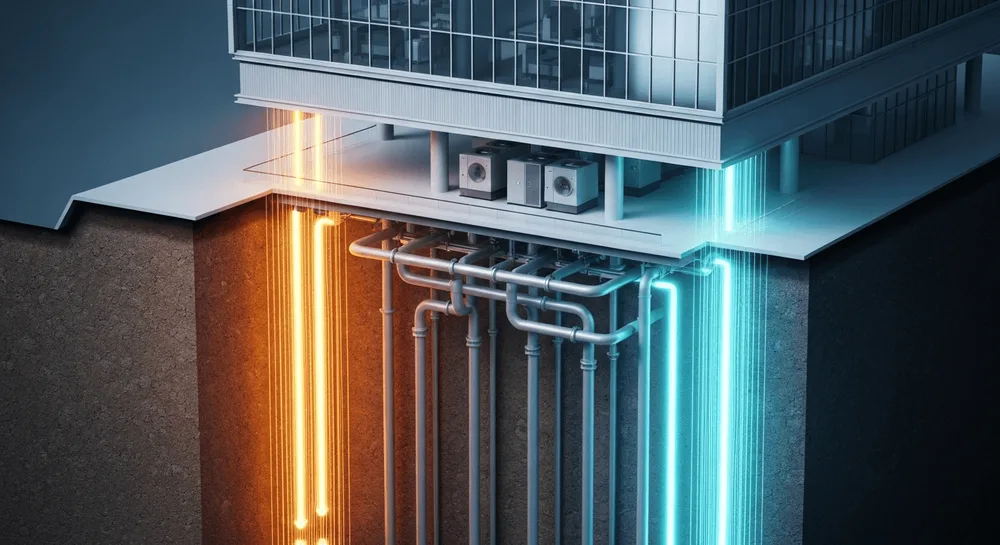
At its core, a geothermal exchange system operates on the same vapor-compression refrigeration principle as any conventional heat pump or air conditioner. The fundamental difference, and the source of its exceptional efficiency, is its use of the earth as a thermal battery. The system consists of three main segments: the ground heat exchanger (the "borefield" or "loop field"), the water-to-refrigerant heat pump unit(s) inside the building, and the building's thermal distribution system. In cooling mode, the heat pump extracts heat from the indoor space, transfers it to a water-based solution (typically water and a food-grade antifreeze) circulating through the ground loop, and rejects that heat into the stable, cooler earth. In heating mode, a reversing valve changes the flow of refrigerant, and the process is inverted: the system extracts low-grade thermal energy from the ground, the heat pump concentrates it to a higher temperature, and delivers it into the building. The key components enabling this are the compressor, which elevates the temperature and pressure of the refrigerant, and two heat exchangers—one exchanging heat with the ground loop water and the other with the building's distribution system.
System Typologies: Closed-Loop, Open-Loop, and Standing Column Wells
Closed-Loop
Sealed pipes circulate fluid. Most common and versatile. Independent of groundwater quality.
Open-Loop
Directly uses groundwater. High thermal efficiency but requires specific hydrogeology and permitting.
Standing Column
Hybrid system in competent rock. Circulates water in a deep well, "bleeding" some water to maintain temperature.
Commercial geothermal systems are predominantly designed using one of three primary typologies, each with specific site requirements and performance characteristics. The most prevalent by far is the closed-loop system. Here, a continuous loop of high-density polyethylene (HDPE) pipe is installed underground, either vertically in boreholes or horizontally in trenches. A heat transfer fluid circulates within this sealed piping, never coming into direct contact with the earth or groundwater. This makes it adaptable to nearly any site geology and avoids complex water use permitting. Open-loop systems, conversely, directly use groundwater as the heat exchange medium. Water is pumped from a supply well, passed through the heat pump's heat exchanger, and then returned to the ground via a separate injection well. While potentially more thermally efficient and less expensive to install due to the absence of extensive piping, they are contingent on a suitable aquifer with sufficient flow and proper water chemistry to prevent equipment fouling. A third, more specialized type is the Standing Column Well (SCW), typically used in regions with competent bedrock. It uses a deep well as both a heat exchanger and a water source, circulating the column of water and often "bleeding off" a small amount to be replaced by fresh groundwater to regulate temperature.
Vertical vs. Horizontal Loop Configurations: Site Constraints and Performance Trade-offs
Vertical Loops
- Small surface footprint
- Accesses stable deep-earth temps
- Higher installation cost per foot
- Ideal for dense urban/commercial sites
Horizontal Loops
- Requires large, open land area
- Influenced by surface temperature swings
- Lower installation cost per foot
- Best for suburban or rural new builds
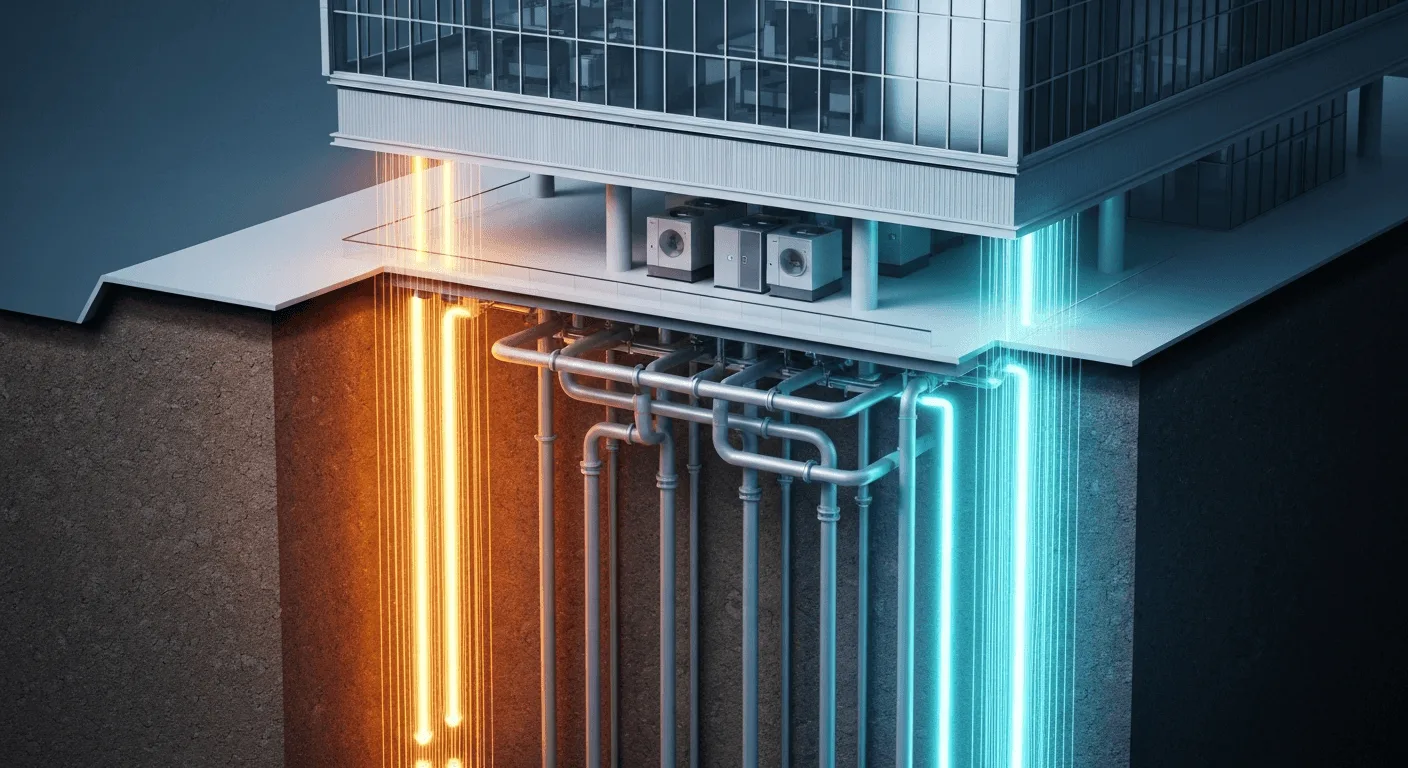
Within closed-loop systems, the choice between vertical and horizontal configurations is dictated almost entirely by site-specific constraints, primarily available land area. For most commercial projects, particularly in urban or dense suburban settings, vertical loops are the only viable option. These involve drilling boreholes typically 150 to 600 feet deep, spaced 15 to 25 feet apart. While the upfront drilling cost is higher, this configuration requires minimal surface area (often installed under parking lots or landscaped areas) and accesses deeper ground where temperatures are more stable year-round, leading to consistent performance. Horizontal loops require extensive land area, as pipes are buried in trenches 6 to 10 feet deep. Several hundred feet of trench per ton of capacity may be needed. This makes them suitable for projects with ample acreage, like schools or sprawling industrial parks, and their excavation-based installation can be less costly than drilling. However, their performance can be slightly less stable as the shallower ground is more susceptible to seasonal temperature fluctuations. The technoeconomic analysis must weigh the higher drilling cost of a vertical system against the land cost and opportunity cost associated with a horizontal system.
The Role of Geothermal Exchange in Building Electrification and Grid-Interactive Strategies
Electrification Enabler
Eliminates on-site fossil fuel combustion, providing all-electric heating at efficiencies unattainable by other electric options.
Grid Asset
Reduces peak demand, improves load factor, and the borefield can act as a thermal battery, supporting grid stability and renewables integration.
Geothermal exchange is a cornerstone technology for the beneficial electrification of the building sector. By providing hyper-efficient electric heating, it solves the primary challenge of electrifying buildings in colder climates, where traditional electric resistance heat is prohibitively expensive to operate and air-source heat pumps suffer significant performance degradation at low ambient temperatures. A GSHP system's heating efficiency is largely independent of outside air temperature, ensuring a stable and manageable electrical load even on the coldest winter days. This characteristic makes geothermal-equipped buildings inherently grid-friendly. Their significantly lower and flatter energy consumption profile reduces peak demand on the electrical grid compared to conventionally-heated-and-cooled buildings. As utilities and grid operators grapple with the intermittency of renewable energy sources, this becomes critically important. Furthermore, advanced control strategies can leverage the thermal mass of the building and the massive thermal storage capacity of the borefield to pre-heat or pre-cool the building during off-peak hours when electricity is cheaper and more abundant, transforming the building into a Grid-Interactive Efficient Building (GEB) that provides value back to the grid.
---Section 2: The "Techno" Analysis - Design, Engineering, and Performance Modeling
Critical Pre-Design Steps: Site Assessment and Thermal Conductivity Testing (TCT)
The Foundation of Accurate Design
1. Site Assessment
Review geology, hydrogeology, utility locations, and site access. Identifies fatal flaws early.
2. Thermal Conductivity Test (TCT)
Drill a test bore and measure the ground's actual ability to transfer heat. This data is essential for right-sizing the borefield.
The technical success of a geothermal project is determined long before the first production drill rig arrives on site. A rigorous pre-design phase is non-negotiable and is centered around two key activities: a comprehensive site assessment and an in-situ Thermal Conductivity Test (TCT). The site assessment is a due diligence exercise that evaluates surface and subsurface conditions. It includes reviewing geological maps to understand soil and rock formations, identifying the depth to bedrock, assessing groundwater conditions, and locating all underground utilities to de-risk the drilling process. This initial step can identify potential challenges or, in rare cases, fatal flaws. Following a positive assessment, the TCT is performed. A test borehole is drilled to the proposed depth of the production wells, a temporary loop is installed, and a known quantity of heat is injected into the ground for a period of 48-72 hours while the temperature response is precisely monitored. This provides an empirical measurement of the ground's thermal conductivity and diffusivity—critical inputs for the borefield design software. Skipping or improperly conducting a TCT forces designers to use conservative "book values," almost always resulting in an oversized and unnecessarily expensive borefield.
Borefield Design and Optimization: Sizing, Spacing, and Grouting for Maximum Efficiency
Sizing (Total Length)
Determined by building loads and ground thermal properties (from TCT).
Spacing (Layout)
Balances thermal interference between bores against land area constraints (typically 20-25 ft).
Grouting (Efficiency)
Thermally enhanced grout ensures maximum heat transfer from pipe to earth.
With accurate load data from the building energy model and thermal property data from the TCT, the borefield can be designed and optimized. The goal is to design the most cost-effective ground heat exchanger that can maintain the circulating fluid temperature within an optimal range (e.g., 30°F to 90°F) over the entire life of the project. This involves a multi-variable optimization of total drilled footage, bore depth, and spacing. Sizing determines the total length of pipe required to meet the building's annual net energy rejection or extraction. Deeper bores generally offer better performance but at a higher drilling cost. Spacing, typically 20-25 feet on center, is critical to prevent thermal interference, where adjacent boreholes negatively impact each other's performance over time. Placing them too close saves space but can lead to long-term heat buildup and reduced system efficiency. A final, crucial element is the grout used to backfill the borehole after the U-bend pipe is inserted. Standard bentonite grout is an environmental seal, but thermally enhanced grout, containing silica sand or other additives, can double the thermal conductivity of the backfill, significantly improving heat transfer and potentially reducing the required number of bores.
Modeling Geothermal Performance: Using Software like GLHEPro, TRNSYS, and EnergyPlus
Building Loads
(EnergyPlus, TRNSYS, eQuest)
Borefield Design & Sizing
(GLHEPro, LoopLink)
Annual Performance Simulation
(Integrated in EnergyPlus/TRNSYS)
Predicting the long-term performance and energy savings of a geothermal system requires sophisticated modeling tools that simulate the dynamic thermal interaction between the building, the heat pumps, and the borefield. The process typically involves a two-step workflow. First, a whole-building energy modeling program like EnergyPlus (the simulation engine behind many commercial software packages) or TRNSYS is used to create an hour-by-hour simulation of the building's heating and cooling loads over a typical meteorological year. This model accounts for building envelope, occupancy, lighting, plug loads, and ventilation. Second, these monthly or hourly load profiles, along with the ground properties from the TCT, are imported into a dedicated ground loop design tool like GLHEPro. This software models the long-term temperature response of the ground to decades of building operation, allowing the designer to size a borefield that will not experience thermal saturation or depletion. Finally, the resulting borefield performance data is fed back into the whole-building model to conduct an integrated simulation, accurately predicting total annual energy consumption, demand profiles, and operational costs. This iterative, data-driven approach is essential for a reliable technoeconomic analysis.
Integration with Building Systems: BAS Controls, Radiant Heating/Cooling, and VAV Systems
High-Performance Pairing
Geothermal + Radiant Systems = Optimal Efficiency. Low-temperature water distribution maximizes heat pump COP/EER.
Controls are Key
A modern Building Automation System (BAS) is essential to manage loop temperatures, optimize pump speeds, and coordinate with ventilation.
A geothermal system's performance is not determined by the borefield alone; its efficiency is heavily dependent on how it is integrated with the building's internal distribution and control systems. The overarching principle is that water-source heat pumps operate more efficiently when the temperature difference (lift) between their source side (the ground loop) and load side (the building) is minimized. Therefore, geothermal systems pair exceptionally well with low-temperature heating and high-temperature cooling distribution systems, such as radiant floors, ceilings, or chilled beams. These systems use large surface areas to heat and cool, requiring moderate water temperatures (e.g., 100°F for heating, 60°F for cooling) that allow the heat pumps to operate at peak efficiency. While geothermal can certainly be integrated with traditional VAV air-handling systems or fan coils, the design must be optimized for larger coils to function with less extreme water temperatures than a conventional boiler/chiller plant would provide. Tying all components together is the Building Automation System (BAS), which must be programmed with control sequences specific to geothermal, such as variable-speed pumping control based on demand, loop temperature optimization, and coordinated operation with the ventilation system.
Key Performance Indicators (KPIs): Coefficient of Performance (COP), Energy Efficiency Ratio (EER), and Annual Energy Consumption
COP (Heating)
Heat Output (kW) ÷ Electrical Input (kW)
GSHP Target: 4.0 - 5.5+
EER (Cooling)
Cooling Output (Btu/h) ÷ Electrical Input (W)
GSHP Target: 20 - 30+
To objectively evaluate and compare the performance of a geothermal system against alternatives, several key performance indicators (KPIs) are used. The most common are the Coefficient of Performance (COP) for heating and the Energy Efficiency Ratio (EER) for cooling. COP is a dimensionless ratio of the thermal energy delivered to the building divided by the electrical energy consumed to produce it. A geothermal system with a COP of 4.5 delivers 4.5 units of heat for every 1 unit of electricity consumed, making it 450% efficient at the point of use. EER measures cooling efficiency and is the ratio of heat removed (in Btu/hour) to the electrical energy consumed (in Watts). Geothermal systems regularly achieve EERs of 20 to 30, significantly higher than the 10-15 EER typical of high-efficiency air-cooled equipment. While COP and EER are crucial instantaneous efficiency ratings, the ultimate metric for the economic analysis is the simulated or measured Annual Energy Consumption (AEC). AEC, expressed in kWh of electricity and therms of natural gas, accounts for part-load performance, seasonal variations, and parasitic energy use (pumps, fans), providing the most accurate basis for calculating operational savings.
---Section 3: The "Economic" Analysis Part I - Deconstructing Capital Expenditures (CapEx)
Itemized Breakdown of First Costs: Drilling, Grouting, Loop Installation, and Manifolding
Geothermal CapEx Components
The ground heat exchanger often represents the single largest cost component, typically 40-60% of the total project budget, driven by local drilling conditions and labor rates.
The capital expenditure for a geothermal system is fundamentally different in structure from that of a conventional HVAC system. The largest and most unique cost center is the ground heat exchanger. This portion of the budget can be broken down into several key line items. Drilling and mobilization, priced per foot of depth, is typically the most significant cost and is highly sensitive to local geology (e.g., drilling in soil vs. hard rock) and labor rates. The cost of the HDPE U-bend piping itself is a smaller but still notable material cost. Grouting, especially with a thermally enhanced product, adds to the per-foot installation cost but pays dividends in performance. Following the borefield installation, horizontal trenching is required to connect all vertical loops to a central location, where they are headered together in large, buried valve vaults or manifolds. The cost of these vaults, along with the extensive fusion welding labor required to connect hundreds of pipes, constitutes the final piece of the exterior scope. Accurately estimating these costs requires detailed quotes from experienced drilling contractors who understand the local subsurface conditions.
Cost Analysis of Interior Mechanical Systems: Heat Pumps, Piping, and Controls
Geothermal Interior Costs
- Water-Source Heat Pumps
- Interior Distribution Piping (2-pipe)
- Circulating Pumps (VFDs)
- Buffer Tanks & Accessories
- BAS Integration & Controls
Conventional System Offsets
- Boilers & Flues
- Chillers
- Cooling Towers & Water Treatment
- Gas Piping & Service
- Large Rooftop or Outdoor Units
While the exterior work is unique, the interior mechanical systems for a geothermal project have direct analogs in conventional designs, allowing for a clearer cost comparison. The primary equipment consists of multiple water-source heat pumps (WSHPs), which are generally comparable in cost to the fan coil units or VAV boxes in a standard hydronic system. The interior piping network that connects these heat pumps to the main mechanical room is typically a simple two-pipe, reverse-return loop, which can be less complex and costly than a four-pipe chilled water/hot water system. Central plant equipment includes the main circulating pumps, which should be specified with variable frequency drives (VFDs) for efficient operation, along with expansion tanks and air separators. A crucial part of a fair economic comparison is to account for the substantial costs *avoided* by choosing geothermal. The budget no longer needs to include line items for boilers, gas piping, flues, chillers, cooling towers, condenser water piping, or large rooftop packaged units. When these avoided costs are properly credited against the geothermal system's interior scope, the net cost premium is often much smaller than initially perceived.
Soft Costs: Engineering Design, Permitting, and Commissioning
Engineering
Geological review, TCT oversight, loopfield design, and integrated mechanical design.
Permitting
Well drilling permits, environmental approvals, and coordination with local authorities (AHJ).
Commissioning
Loop flushing/purging, fluid testing, system balancing, and controls verification (Cx).
Beyond the "hard costs" of materials and labor, a comprehensive CapEx analysis must account for the associated soft costs, which can represent 10-20% of the total project budget. Engineering design fees for a geothermal project are typically higher than for a conventional system due to the specialized expertise required. This includes the cost of a hydrogeologist to perform the initial site assessment, the supervision and analysis of the TCT, and the detailed borefield design and modeling, in addition to the standard mechanical engineering for the interior systems. Permitting can also be more involved, often requiring specific well-drilling permits from state or local environmental agencies, which may add time and cost to the pre-construction phase. Finally, commissioning (Cx) is a critical soft cost that ensures the installed system operates as designed. For geothermal, this includes specialized procedures like flushing and purging the loop field to remove all air and debris, verifying the proper glycol concentration in the fluid, balancing flow to all heat pumps, and functionally testing the BAS control sequences. Investing in thorough commissioning is essential to realize the modeled energy savings.
Benchmarking CapEx: Cost per Ton and Cost per Square Foot vs. Conventional HVAC (VAV with Chillers/Boilers, VRF)
Typical First Cost Premiums
Geothermal system first costs are typically higher than conventional options, but the premium varies based on the baseline system.
Geothermal: $25 - $45 / sq.ft.
Common Baseline Systems
- vs. VAV w/ Chiller/Boiler:
15-30% Higher CapEx - vs. VRF System:
10-25% Higher CapEx
To put the capital cost into perspective, it's useful to benchmark geothermal CapEx against the systems it typically replaces. Common metrics are cost per ton of capacity and cost per square foot of conditioned area. A full geothermal system installation can range from $7,000 to $12,000 per ton, or $25 to $45 per square foot, though these figures are highly dependent on project scale, location, and complexity. A conventional VAV system with a central chiller and boiler plant might cost $20 to $30 per square foot. A Variable Refrigerant Flow (VRF) system, another popular all-electric option, could fall in the range of $22 to $35 per square foot. This analysis reveals that geothermal systems almost always carry a first-cost premium. When benchmarked against a VAV system, the premium might be 15-30%. When compared to a high-performance VRF system, the premium may be smaller, perhaps 10-25%. It is this specific premium, calculated for the project's unique baseline, that forms the basis for payback, ROI, and IRR calculations. A true "apples-to-apples" comparison must include the full scope of both systems, including all associated infrastructure like gas lines, flues, and cooling tower structural support that geothermal avoids.
 ---
---
Section 4: The "Economic" Analysis Part II - Lifecycle Costing and Operational Value (OpEx)
Quantifying Energy Savings: Modeling Reduced Electricity and Fossil Fuel Consumption
Baseline Energy Use (VAV)
Geothermal Energy Use
The primary driver of geothermal's economic value is the drastic reduction in operational energy consumption. This is where the initial CapEx premium is paid back. The quantification of these savings begins with the outputs from the integrated whole-building energy models (e.g., EnergyPlus) for both the proposed geothermal design and the baseline conventional system. The model provides a detailed, hour-by-hour breakdown of energy use, allowing for a precise calculation of savings. First, all fossil fuel consumption for space heating and service hot water is eliminated, yielding savings equal to the total volume of natural gas or oil previously purchased. Second, electricity consumption for cooling is significantly reduced due to the high EER of the ground-source heat pumps compared to air-cooled chillers or condensers. While heating mode does consume electricity where a gas boiler did not, the high COP of the geothermal system means this new electrical load is far smaller than the electrical savings realized from cooling and the elimination of boiler fans and pumps. The net result is a 40-70% reduction in total HVAC energy use, which, when multiplied by local utility rates, provides a robust, defensible projection of annual dollar savings.
Drastically Lowered Maintenance Costs: Eliminating Cooling Towers, Boilers, and Condensers
Maintenance Cost Reduction
By moving all heat exchange equipment indoors or underground, geothermal systems eliminate the most maintenance-intensive components of conventional HVAC.
✗ Annual Boiler Inspection/Cleaning
✗ Cooling Tower Water Treatment
✗ Condenser Coil Cleaning
✗ Refrigerant Leak Repairs
✗ Outdoor Equipment Weather Damage
Beyond energy, a significant and often underestimated source of operational savings comes from reduced maintenance. Conventional HVAC systems rely on outdoor equipment that is constantly exposed to the elements, leading to degradation and frequent service calls. A geothermal system has no such equipment. This design eliminates entire categories of maintenance, repair, and replacement costs. The annual expense of professional cooling tower cleaning and chemical water treatment—a significant line item for any building with a chilled water plant—is completely removed. Likewise, annual boiler inspections, tube cleaning, and combustion tuning are no longer necessary. There are no outdoor condenser coils to be damaged by hail or clogged by dust and debris. The heat pumps themselves are located indoors in protected mechanical spaces, simplifying service access and extending their operational life. Maintenance activities are reduced to periodic filter changes, indoor pump inspection, and control sequence verification. These savings, which can amount to several dollars per square foot per year, are consistent, predictable, and directly improve a property's Net Operating Income (NOI).
Asset Longevity and Replacement Schedules: Comparing 50+ Year Ground Loops to 15-20 Year Conventional Equipment
Geothermal Asset Lifespan
Ground Loop & Piping
50 - 100+ Years
Interior Heat Pumps
20 - 25 Years
Conventional Asset Lifespan
Chillers, Boilers, Cooling Towers, Rooftop Units
15 - 20 Years
A true lifecycle cost analysis must look beyond initial costs and annual savings to account for long-term capital replacement. This is where geothermal's value proposition becomes overwhelmingly compelling. The ground heat exchanger, comprised of inert HDPE piping and grout, has an expected lifespan of over 50 years, with many industry estimates extending to 100 years. It is a permanent infrastructure investment. The interior heat pumps, operating in a stable, protected environment, have a typical service life of 20-25 years. In stark contrast, conventional HVAC equipment like chillers, boilers, and cooling towers has an average service life of only 15-20 years. This means that over a 50-year analysis period, a building owner with a conventional system must budget for a full replacement of their entire central plant two to three times. With a geothermal system, the owner replaces the interior heat pumps twice, but the most expensive component—the ground loop—is paid for only once. This dramatically reduces the long-term capital burden, future-proofing the building and stabilizing the capital budget for decades.
Calculating Total Cost of Ownership (TCO) and Net Present Value (NPV)
Total Cost of Ownership (TCO) Over 30 Years
Geothermal TCO =
Initial CapEx
+ (Annual OpEx x 30 years)
+ (1x Heat Pump Replacement)
- (Incentives)
Conventional TCO =
Initial CapEx
+ (Annual OpEx x 30 years)
+ (1-2x Full Plant Replacements)
Total Cost of Ownership (TCO) synthesizes all the economic factors into a single, comprehensive comparison. The TCO is calculated over a long-term horizon (typically 20-30 years) and includes the initial capital expenditure, the cumulative sum of all annual operational costs (energy and maintenance), and the projected cost of capital equipment replacement during the analysis period. When plotted over time, the TCO for a conventional system starts lower but rises steeply, punctuated by large capital outlays for equipment replacement. The geothermal TCO starts higher but has a much flatter slope due to lower annual OpEx, and its only major capital event is the replacement of the interior heat pumps. In most commercial projects, the TCO lines cross within 7-15 years, after which the geothermal system becomes the unequivocally cheaper asset to own. To make an investment decision, however, stakeholders need to understand this future value in today's dollars. This is achieved by calculating the Net Present Value (NPV) of the project. NPV discounts all future cash flows (both savings and expenses) back to the present using a chosen discount rate, providing a clear measure of the project's profitability and its value creation for the organization.
---Section 5: Financial Engineering - Unlocking Project Viability and ROI
Navigating the Incentive Landscape: Federal ITC, MACRS Depreciation, and Utility Rebates
Federal ITC
Directly reduces tax liability by 30-40%+ of the eligible project cost, dramatically cutting the net CapEx.
MACRS
Allows for accelerated depreciation of the system, creating significant tax shields in the early years of operation.
Utility Rebates
Many utilities offer per-ton or performance-based incentives for installing high-efficiency geothermal systems.
The upfront cost premium of geothermal systems can be substantially mitigated by leveraging a powerful stack of financial incentives. The most impactful of these is the U.S. Federal Business Energy Investment Tax Credit (ITC). Following the Inflation Reduction Act of 2022, commercial geothermal projects are eligible for a base credit of 30% of the total installed cost, which can be increased to 40% or even 50% with adders for meeting domestic content and prevailing wage requirements (Source: energy.gov). This credit is not a deduction but a dollar-for-dollar reduction of federal tax liability, effectively acting as a massive discount on the system's CapEx. In addition to the ITC, the entire project cost can be depreciated on an accelerated schedule under the Modified Accelerated Cost Recovery System (MACRS), creating a further tax shield that boosts early-year cash flows. On a local level, many electric utilities offer significant rebates, either on a per-ton basis or as part of a custom performance-based program, to incentivize the adoption of this grid-friendly technology. Properly modeling and monetizing this full stack of incentives is a critical step in the financial analysis and can often reduce the project's simple payback period by several years.
Financing Models for Geothermal Projects: PACE, Energy Service Agreements (ESAs), and EaaS
Traditional (CapEx)
Building owner pays for the system upfront and reaps 100% of the savings and incentives.
Third-Party (OpEx)
A service provider owns the geothermal asset, and the owner pays a monthly fee for heating/cooling, avoiding the initial CapEx.
For building owners who lack the upfront capital or tax appetite to fund a geothermal project directly, several innovative financing models have emerged to shift the investment from a capital expenditure to an operational expenditure. Property Assessed Clean Energy (PACE) financing allows property owners to fund energy efficiency projects with a special assessment placed on their property tax bill. The loan is tied to the property, not the owner, and is paid back over a long term (up to 30 years), often resulting in immediate positive cash flow as the annual energy savings exceed the annual PACE payment. An even more transformative model is the Energy Service Agreement (ESA) or Energy-as-a-Service (EaaS) model. In this structure, a third-party entity finances, owns, and maintains the geothermal system. The building owner pays nothing upfront and instead signs a long-term contract to purchase heating and cooling services at a predetermined, often fixed rate that is lower than their current utility cost. This allows the building to reap the operational and environmental benefits of geothermal with zero capital outlay. Managing the complexities of these agreements is streamlined through specialized platforms; for more information on how to structure and track such arrangements, you can explore resources and tools at https://jisenergy.com/sign-up-login/.
Calculating Simple Payback, Internal Rate of Return (IRR), and Return on Investment (ROI)
Simple Payback
Net Investment ÷ Annual Savings. Easy to understand but ignores time value of money.
ROI
(Net Profit ÷ Cost of Investment) x 100. A percentage measure of profitability.
IRR
The discount rate at which NPV equals zero. The most sophisticated metric for comparing investments.
With all costs, savings, and incentives quantified, the project's financial viability can be assessed using standard investment metrics. Simple Payback is the most straightforward: it is the net capital investment (CapEx minus incentives) divided by the total annual OpEx savings. While easy to communicate, it is a limited metric as it ignores cash flows after the payback period and the time value of money. Return on Investment (ROI) provides a percentage measure of the project's profitability, typically calculated over a specific time horizon. A more sophisticated and powerful metric is the Internal Rate of Return (IRR). IRR is the discount rate at which the Net Present Value (NPV) of all project cash flows (initial investment, annual savings, and future capital replacements) equals zero. In essence, it represents the project's effective annualized rate of return. An IRR that exceeds the company's minimum acceptable rate of return (or "hurdle rate") signals a financially attractive investment. For a well-designed commercial geothermal project with incentives, post-tax IRRs in the range of 8-15% are commonly achievable, making a compelling case against other potential uses of capital.
Monetizing Non-Energy Benefits: Improved Property Value, Tenant Comfort, and ESG Ratings
Tangible Financial Value
Improved NOI leads to a direct increase in property valuation (capitalization rate).
Market & Tenant Value
Higher ESG scores, LEED points, superior comfort, and silent operation attract premium tenants and can justify higher lease rates.
A purely quantitative analysis of energy and maintenance savings may understate the full economic impact of a geothermal conversion. There are numerous "non-energy benefits" that can be monetized or contribute directly to asset value. The most direct is the impact on property valuation. Since commercial property value is often determined by capitalizing the Net Operating Income (NOI), every dollar saved on OpEx directly increases the NOI and, by extension, the building's appraised value. Furthermore, in a market increasingly driven by sustainability metrics, a building with a geothermal system boasts a superior Environmental, Social, and Governance (ESG) profile. This can attract high-value "green" tenants, improve tenant retention, and potentially command higher rental rates. The elimination of noisy outdoor equipment improves occupant experience and leasable space value. The system's resilience to extreme weather events and fuel price volatility provides an operational risk mitigation benefit. While harder to quantify than a utility bill, these benefits are real and should be qualitatively, if not quantitatively, factored into the overall investment decision, as they contribute to a more competitive and valuable long-term asset.
---Section 6: Advanced Geothermal Concepts and Future Trends
Hybrid Geothermal Systems: Augmenting with Cooling Towers or Boilers for Extreme Peak Loads
Hybrid System Strategy
Size the borefield to handle 95% of the annual load (the base). Use smaller, less expensive conventional equipment to assist only during the few hours of extreme peak demand per year. This optimizes first cost without significantly impacting overall energy efficiency.
While a full geothermal system is designed to handle 100% of a building's heating and cooling load, a hybrid approach can be a cost-effective strategy for certain building types, particularly those with highly unbalanced or "peaky" loads (e.g., a data center with a massive, constant cooling load). In a hybrid system, the geothermal borefield is intentionally undersized to handle the majority (e.g., 90-95%) of the annual thermal load, but not the absolute peak demand which may only occur for a few dozen hours per year. This peak load is then met by a smaller, supplemental piece of conventional equipment. For a cooling-dominated building, this might be a fluid cooler or a small cooling tower that assists the borefield on the hottest summer days. For a heating-dominated building, a small, high-efficiency condensing boiler could provide supplemental heat during extreme cold snaps. The goal of this technoeconomic trade-off is to significantly reduce the initial CapEx by shrinking the most expensive component—the borefield—at the cost of a very small decrease in overall annual efficiency. This can make projects financially viable in cases where a 100% sized borefield would be prohibitively expensive.
Thermal Energy Networks: The "Geothermal Utility" Model for Campuses and Districts
Shared Loop
A common ambient-temperature water loop connects multiple diverse buildings.
Load Sharing
Waste heat from a cooling-dominant building is used by a heating-dominant building, reducing the load on the central borefield.
The next frontier for geothermal exchange is its application at the community or district scale through Thermal Energy Networks (TENs). Also known as geo-microdistricts or ambient loops, this concept treats geothermal not as a building-specific system, but as a shared public utility, much like water, sewer, or electricity. A large, shared borefield and piping network is installed to serve an entire campus, neighborhood, or development. Individual buildings then simply connect to this ambient-temperature loop and use their own internal heat pumps to extract or reject heat as needed. The key advantage of this approach is load diversity. At any given time, some buildings in the network will be in cooling mode (rejecting heat to the loop) while others are in heating mode (extracting heat from the loop). This allows for highly efficient energy sharing, where one building's waste heat becomes another's energy source, dramatically reducing the required size of the central borefield and improving overall system efficiency. This utility-scale model amortizes the high capital cost of the borefield over many customers and decades, making hyper-efficient heating and cooling accessible and affordable for all connected buildings. (Source: NREL.gov)
Waste Heat Recovery and Simultaneous Heating/Cooling Opportunities
Heat Source
(Data Closet, Kitchen, Gym)
Water-Source Heat Pump
(Captures & Upgrades Heat)
Useful Heat Sink
(Domestic Hot Water, Space Heating)
Water-source heat pump systems, which form the core of a geothermal design, are exceptionally effective at waste heat recovery. Many modern commercial buildings have zones with simultaneous heating and cooling demands; for instance, the building perimeter may require heating on a cold, sunny day, while the core, with its people, lights, and equipment, requires cooling. In a conventional system, the boiler would burn gas to create heat while the chiller would consume electricity to reject heat outdoors. A geothermal system can handle this intelligently. The heat pumps in the core zones reject their waste heat into the shared water loop, raising its temperature slightly. The heat pumps on the perimeter then extract this "free" heat from the loop to satisfy their heating demand. The net load on the ground loop is minimized, and the system operates at an extraordinarily high efficiency. This principle can be extended to capture waste heat from any source, such as server rooms or commercial refrigeration, and use it for beneficial purposes like pre-heating domestic hot water, providing a powerful opportunity to further reduce a building's overall energy footprint.
Geothermal Borefields as Thermal Batteries for Long-Duration Energy Storage
Summer (Charging)
Excess heat from building cooling is actively injected and stored in the deep earth, raising its temperature.
Winter (Discharging)
The stored summer heat is extracted by the heat pumps, providing highly efficient heating.
The most forward-looking application of geothermal technology is to operate the borefield not merely as a heat exchanger, but as a massive, inter-seasonal thermal battery. This concept, known as Aquifer or Borehole Thermal Energy Storage (ATES/BTES), involves actively managing the temperature of the subsurface over the course of a year. In a cooling-dominated building, for example, instead of just rejecting heat to the ground during the summer, the system can be controlled to intentionally "charge" the borefield, raising the temperature of a large volume of earth. Then, months later in the winter, the heat pumps can extract this stored heat to warm the building. This process significantly boosts heating mode efficiency, as the heat pumps are drawing from a 60-70°F source instead of the natural 55°F ground temperature. The reverse can be done in heating-dominated climates, using winter cold to "pre-cool" the ground for more efficient summer air conditioning. As a form of long-duration energy storage, BTES can help balance the grid, store excess renewable energy as thermal energy, and maximize the performance and economic return of the geothermal asset.
---Section 7: Case Study - A Technoeconomic Breakdown of a Commercial Office Retrofit
Project Profile: Building Size, Age, and Existing HVAC System Challenges
Building
120,000 sq.ft. 1985 Office
Existing System
End-of-life VAV with Boiler/Chiller
Challenges
High OpEx, Impending CapEx, Tenant Complaints
This case study examines a 120,000 ft², six-story commercial office building originally constructed in 1985. The property was facing a critical capital decision point. Its original HVAC system—a constant-volume VAV system served by a central water-cooled chiller, a gas-fired boiler, and an aging cooling tower—had reached the end of its useful life. The building owner was facing a multi-million-dollar capital replacement project for like-for-like equipment. Moreover, the existing system was highly inefficient, resulting in exorbitant utility bills that hampered the property's NOI. Tenant comfort was a persistent issue, with frequent complaints of uneven temperatures and drafts. The combination of high operational expenditures, a looming capital cliff, and pressure to improve the building's sustainability profile prompted the owner to explore a full HVAC modernization, with a geothermal exchange system as the primary option. The goal was to find a solution that not only replaced the failing equipment but also repositioned the building as a high-performance, Class-A asset.
The Geothermal Solution: System Design, Borefield Specifications, and Implementation Process
Exterior Scope
Installation of a 180-bore vertical field, each 500 feet deep, located under the existing rear parking lot. Thermally enhanced grout was used to maximize performance.
Interior Scope
Replacement of the central plant with a variable-speed pumping station. New, decentralized water-to-air heat pumps were installed on each floor to serve the existing VAV boxes.
Following a successful feasibility study and TCT, a vertical closed-loop geothermal system was designed. The borefield consisted of 180 boreholes, each drilled to a depth of 500 feet, for a total of 90,000 feet of drilling. The field was installed under the building's main parking lot, minimizing site disruption and preserving green space. The implementation was phased to mitigate impact on tenants. The exterior drilling work was completed first. Inside, the aging chiller, boiler, and cooling tower were decommissioned and removed, freeing up significant mechanical room space. A new, compact pumping and distribution module with VFDs was installed to circulate water between the borefield and the building. On a floor-by-floor basis, the old central air handlers were replaced with modular water-to-air heat pumps that connected to the existing VAV ductwork, allowing for a cost-effective reuse of the building's air distribution infrastructure. This hybrid approach—a new geothermal central plant paired with existing distribution—balanced first cost with performance goals. The new system was fully integrated into a modern BAS for optimal control and monitoring. (Source: IGSHPA.org)
Financial Deep Dive: Actual Project CapEx, Incentives Captured, and First-Year OpEx Savings
Total CapEx
$4.2 M
CapEx Premium
$1.5 M
(vs. $2.7M for new chiller/boiler)
Net Investment
$0.22 M
(After $1.28M in ITC & Rebates)
The total capital cost for the geothermal retrofit was $4.2 million. The engineer's estimate for a like-for-like replacement of the conventional plant was $2.7 million, resulting in a gross CapEx premium of $1.5 million for the geothermal option. However, the financial engineering of the project transformed its economics. The project qualified for the 30% Federal ITC, providing a tax credit of $1,260,000. Additionally, a custom rebate from the local utility for demand reduction and electrification added another $20,000. This reduced the effective net investment premium to just $220,000. In the first year of operation, the building's metered energy use was analyzed. Total electricity consumption for HVAC dropped by 440,000 kWh, and natural gas consumption was completely eliminated (a savings of 38,000 therms). At local utility rates, this translated to an annual energy savings of $125,000. Furthermore, the building's maintenance contract was renegotiated, yielding an additional $35,000 in annual savings from the elimination of boiler and cooling tower service. The total first-year OpEx savings of $160,000 resulted in a simple payback of just 1.4 years on the net investment premium.
Performance Verification: Measured Energy Use vs. Models and Post-Install Payback Realignment
Modeled Savings (Pre-Design)
$145,000 / Year
Measured Savings (Year 1)
$160,000 / Year
A critical final step in the project was to validate the real-world performance against the pre-construction energy models. The building's utility meters were sub-metered to isolate the HVAC loads, and this data was collected through the BAS for the first 18 months of operation. The initial EnergyPlus model had predicted annual OpEx savings of approximately $145,000. The measured savings of $160,000 exceeded this projection by over 10%. A post-mortem analysis attributed this positive variance to two factors: the conservative assumptions used in the model for equipment efficiency and slightly higher-than-projected utility rate inflation. This real-world data allowed for a "realignment" of the financial pro forma. The initial payback projection of 1.5 years was confirmed and even slightly bettered. This process of Measurement and Verification (M&V) was crucial for the building owner, as it provided empirical proof of the system's performance and validated the technoeconomic analysis that underpinned the investment decision. It also created a powerful data set to inform future portfolio-wide energy projects.
Lessons Learned: Key Takeaways for Developers, Engineers, and Contractors
For Developers
Incentives are a game-changer. A TCO/NPV analysis, not simple payback on gross cost, reveals the true value.
For Engineers
An accurate TCT is non-negotiable. It de-risks the design and prevents costly oversizing of the borefield.
For Contractors
Phasing and logistics are key in a retrofit. Close coordination between drillers and mechanical trades is essential.
This successful retrofit offers several critical lessons for future projects. For developers and owners, the primary takeaway is the need to look past the initial CapEx premium and conduct a thorough lifecycle analysis that properly incorporates all available incentives. The ITC fundamentally changes the investment calculus. For the engineering team, the project reinforced the absolute necessity of an on-site TCT. The test results allowed for a more aggressive, optimized borefield design that saved over $300,000 in drilling costs compared to a design based on conservative book values. For the construction and contracting team, the project highlighted the importance of logistical planning in an occupied building retrofit. Careful scheduling of drilling activities to off-hours and a clear floor-by-floor interior renovation plan were essential to minimizing disruption to the tenants. Finally, the project demonstrated the value of an integrated design process, where the developer, engineers, and key contractors collaborated from the early feasibility stage to align on goals, constraints, and costs, ensuring a smooth and successful project delivery.
---Conclusion: The Strategic Imperative for Geothermal Exchange Systems
Synthesizing the Technoeconomic Argument: Why Geothermal is a Superior Long-Term Asset
Lower Risk
Insulated from fuel price volatility. No exposure to future carbon taxes. Resilient to extreme weather.
Higher Return
Dramatically lower OpEx and capital replacement costs lead to a superior Total Cost of Ownership and higher property valuation.
The preceding analysis demonstrates that the decision to invest in a geothermal exchange system is not merely an environmental choice, but a sophisticated financial strategy. While conventional HVAC systems may offer a lower initial price tag, this "savings" is a mirage that evaporates under the scrutiny of a lifecycle cost analysis. Geothermal systems deliver a powerful combination of drastically reduced energy and maintenance costs, unparalleled asset longevity, and insulation from volatile energy markets. When coupled with transformative financial incentives like the Federal ITC, the economic argument becomes undeniable. The technology transforms a building's largest operational liability into a resilient, high-performance asset. By fundamentally de-risking future operating budgets and capital replacement cycles, a geothermal system offers a lower Total Cost of Ownership and a higher Net Present Value than any conventional alternative. It is an investment in long-term operational excellence and asset value preservation.
The Future Outlook: Geothermal as a Cornerstone Technology for Net-Zero Buildings
The Efficiency Foundation
Geothermal provides the ultra-efficient thermal foundation upon which a net-zero building can be built.
The Renewable Syzergy
Its low energy use makes on-site renewables (like solar PV) viable to offset 100% of the building's energy consumption.
As the real estate industry accelerates toward a net-zero carbon future, geothermal exchange will transition from a "niche" technology to a foundational one. The path to net-zero energy for most buildings relies on a simple formula: radical energy use reduction first, followed by on-site renewable energy generation to meet the remaining load. Geothermal is the most powerful tool available for the reduction side of this equation. Its ability to slash HVAC energy use by up to 70% makes achieving net-zero a practical and economically viable goal. A building with a geothermal system requires a significantly smaller and less expensive solar PV array to offset its annual energy consumption compared to a building with conventional electric heating and cooling. Furthermore, as grid-interactive building controls and thermal energy networks become more prevalent, geothermal systems will serve as key assets for grid flexibility and large-scale decarbonization. They are not simply a better HVAC system; they are a critical enabling technology for the high-performance buildings of the 21st century.
A Call to Action: How to Initiate a Geothermal Feasibility Study for Your Next Project
Step 1: Preliminary Assessment
Gather building data (size, use, utility bills) and conduct a high-level site review for borefield feasibility.
Step 2: Financial Pro Forma
Develop a conceptual design and a preliminary technoeconomic model to estimate CapEx, OpEx, incentives, and key financial metrics.
For any new construction project or major building renovation, a geothermal feasibility study should be a standard part of the initial due diligence process. The path to exploring this technology is straightforward. It begins with engaging a qualified geothermal engineering consultant. The first step is a high-level screening, where the engineer will review the building's size, occupancy, and energy loads, as well as the site's basic geology and available space for a borefield. If this initial screening is positive, the next step is a more detailed feasibility study. This study will involve a preliminary building energy model, a conceptual borefield layout, a budgetary cost estimate for the full system, and a comprehensive financial pro forma that models the TCO, NPV, and IRR against a conventional baseline system. This relatively low-cost study provides the data-driven business case needed for stakeholders to make an informed decision. By taking this proactive step, building owners and developers can unlock the immense long-term value that geothermal exchange offers, securing a competitive advantage in an increasingly energy-conscious market.
A robust geothermal technoeconomic analysis requires integrating TCO, NPV, and complex incentives, which is where specialized modeling platforms become essential. Learn more at https://jisenergy.com Try CogenS free at https://cogens.jisenergy.com