The Grid-Scale Showdown: A Technoeconomic Analysis of Sodium-Ion vs. LFP BESS and the Impact on LCOS
Introduction: The Shifting Landscape of Grid-Scale Energy Storage
***LFP (LiFePO₄)
Based on the intercalation of small Lithium ions (Li+) into a stable, olivine-structured iron phosphate cathode and a graphite anode. A mature and dominant chemistry in grid storage.
Sodium-Ion (Na-ion)
Operates on a similar "rocking-chair" principle but utilizes larger, more abundant Sodium ions (Na+). This requires different host materials, such as hard carbon for the anode and layered metal oxides for the cathode.
Section 1: Unpacking the Contenders: A Primer on LFP and Sodium-Ion Chemistries
The battle for grid-scale dominance begins at the atomic level. Lithium Iron Phosphate (LFP) has firmly established itself as the go-to chemistry for stationary storage, supplanting nickel-manganese-cobalt (NMC) due to its superior safety, longer cycle life, and the avoidance of costly and controversial cobalt. The LFP cell architecture is built upon the well-understood mechanism of lithium-ion intercalation within a remarkably stable olivine-phosphate crystal structure. This structural integrity is the source of its safety and longevity. In contrast, sodium-ion (Na-ion) technology, while conceptually similar, presents a fascinating divergence. It replaces the lithium ion with the much larger and more abundant sodium ion. This seemingly simple substitution has profound implications for material science. The graphite anodes ubiquitous in LFP cells are unsuitable for the larger sodium ions, necessitating the use of alternative materials like hard carbon. Cathodes are also distinct, often employing layered oxides like Prussian blue analogues or sodium-based metal oxides. While LFP represents a highly optimized and mature technology, Na-ion is an emerging challenger built on a foundation of elemental abundance and cost-disruptive potential.
***BESS Performance Metric Scorecard
Section 2: Head-to-Head Technical Performance Metrics for BESS Applications
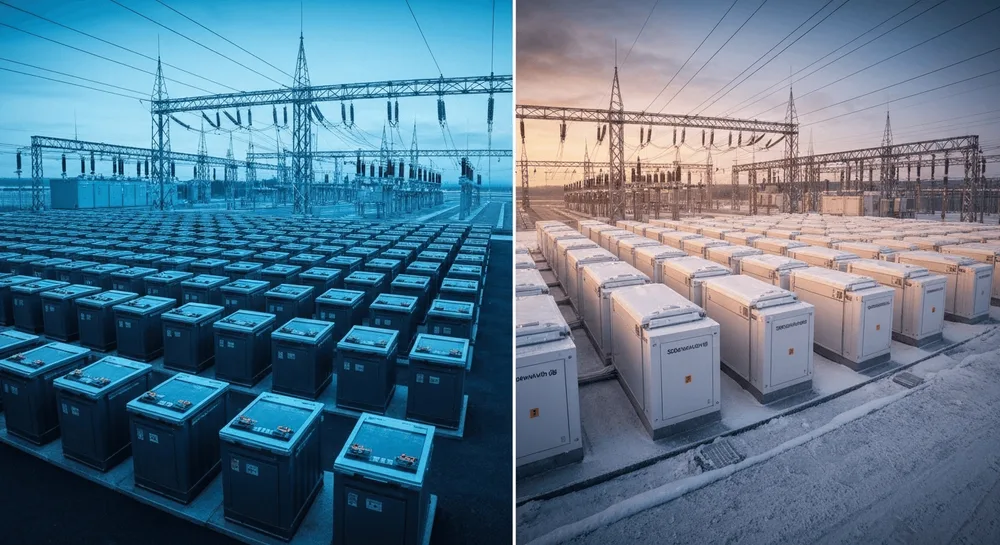
When evaluating BESS technologies, a suite of technical metrics determines their suitability for specific grid services. LFP currently leads in volumetric and gravimetric energy density (140-180 Wh/kg), enabling more MWh of storage within a standard container footprint. Na-ion technology is closing the gap, with commercial cells reaching 160 Wh/kg, but generally remains about 15-20% less dense. This means a Na-ion BESS may require a larger physical footprint for the same energy capacity. In terms of cycle life, LFP is the proven workhorse, with top-tier cells demonstrating well over 6,000 cycles at meaningful depth-of-discharge, a critical factor for high-throughput applications like frequency regulation. Na-ion is demonstrating promising longevity in the lab, with many manufacturers now guaranteeing 3,000-5,000 cycles, making it viable for daily cycling applications like solar peak-shifting. However, Na-ion's standout feature is its exceptional thermal performance. It maintains over 90% capacity retention at -20°C, a temperature at which LFP performance degrades significantly without active heating. This dramatically reduces parasitic loads from thermal management systems in colder climates. Round-trip efficiency is comparable, with LFP holding a slight edge (92-95%) over Na-ion (90-92%).
***Comparative Safety Profile
LFP BESS
Inherently stable olivine structure significantly reduces thermal runaway risk compared to NMC/NCA. Considered the safety benchmark for Li-ion.
Sodium-Ion BESS
Excellent thermal stability due to lower chemical reactivity. Crucially, can be safely discharged to 0V for transport, eliminating stored energy risk during logistics.
Section 3: The Critical Factor of Safety: Thermal Runaway, Management, and System Design Implications
In the context of multi-megawatt BESS installations, safety is non-negotiable. LFP chemistry earned its market-leading position largely due to its superior safety profile over energy-dense but volatile cobalt-based cathodes. The strong phosphorus-oxygen bonds in the LFP crystal structure make it highly resistant to oxygen release during abuse conditions, which is a primary driver of thermal runaway. This inherent stability simplifies the requirements for Battery Management Systems (BMS) and thermal management, reducing system complexity and cost. Sodium-ion chemistry elevates this safety paradigm. Na-ion electrolytes are generally less flammable, and the chemistry exhibits a lower propensity for thermal runaway during overcharging or short-circuit events. A transformative safety advantage for Na-ion is the ability to be fully discharged to zero volts without damaging the cell structure. This allows for completely inert shipment and storage, a major logistical and safety benefit that de-risks transportation and on-site handling. For system integrators, this intrinsic safety, combined with the wider operating temperature window, can translate into significant Balance of System (BOS) cost reductions, potentially requiring less sophisticated and energy-intensive fire suppression and HVAC systems compared to even the safest Li-ion variants.
***Raw Material Economics & Geopolitics
LFP Supply Chain
Reliant on Lithium, which has a concentrated supply chain and high price volatility. Also requires processed graphite and high-purity phosphoric acid.
Sodium-Ion Supply Chain
Utilizes abundant Sodium from common salt and eliminates copper foil in the anode, using cheaper Aluminum. Less geopolitical concentration.
Section 4: Supply Chain and Raw Material Economics: De-risking Long-Term BESS Investments
The long-term technoeconomic viability of a BESS technology is inextricably linked to the stability and cost of its underlying raw materials. The LFP supply chain, while more favorable than NMC, is still fundamentally dependent on lithium. As documented by the U.S. Geological Survey, lithium resources are geographically concentrated, and the rapid electrification of transport and energy sectors has led to significant price volatility and supply chain bottlenecks (Source: usgs.gov). This creates long-term price uncertainty for LFP BESS projects. Sodium-ion technology directly addresses this vulnerability. Sodium is one of the most abundant and universally available elements on Earth, with effectively limitless supply from seawater and terrestrial deposits, insulating it from the geopolitical tensions and price fluctuations affecting the lithium market. Furthermore, Na-ion cell design replaces the copper current collector on the anode side with aluminum, another widely available and significantly cheaper metal. This "design-for-abundance" approach not only promises a lower baseline material cost but also creates a more resilient and geographically diversified supply chain. For investors and asset owners, this translates into reduced long-term commodity risk and a more predictable cost trajectory for future BESS deployments.
***Project Cost Breakdown: LFP vs. Na-ion
CAPEX (Upfront Cost)
Na-ion Advantage: Potentially 20-40% lower cell cost due to cheap raw materials.
LFP Advantage: Higher energy density can reduce land and Balance of System (BOS) costs.
OPEX (Operating Cost)
Na-ion Advantage: Wider operating temperature range significantly reduces HVAC energy consumption, a major OPEX component.
LFP Advantage: Mature systems with well-understood degradation and maintenance schedules.
Section 5: Deconstructing Project Costs: A Comparative Analysis of CAPEX and OPEX
A comprehensive BESS technoeconomic analysis extends beyond the cell to the entire project's lifecycle costs, encompassing both Capital Expenditures (CAPEX) and Operational Expenditures (OPEX). On the CAPEX front, Na-ion's primary advantage lies in its potential for significantly lower battery pack costs, driven by inexpensive raw materials. Projections suggest Na-ion cells could achieve a cost point 20-40% below equivalent LFP cells at scale. However, this is partially offset at the system level. Na-ion's lower energy density may necessitate more containers, concrete pads, and cabling for the same MWh capacity, slightly increasing Balance of System (BOS) costs. LFP's density advantage helps minimize this footprint-related CAPEX. The more compelling differentiator emerges in OPEX. A significant operational cost for BESS is the energy consumed by the HVAC system to maintain the batteries within their optimal temperature range (typically 15-35°C for LFP). Na-ion's ability to operate efficiently across a much wider temperature spectrum (-20°C to 45°C) dramatically reduces this parasitic HVAC load. This can lead to substantial lifelong energy savings, lower maintenance on thermal management equipment, and improved net system efficiency, making Na-ion particularly attractive for projects in harsh climates.
***
The LCOS Equation: Unlocking True Project Value
↓ Lower CAPEX (cell cost)
↓ Lower OPEX (HVAC savings)
~ Comparable Throughput
~ Mature CAPEX (scale)
↑ Higher OPEX (HVAC)
↑ Higher Proven Throughput
Section 6: The Ultimate Metric: A Deep Dive into Sodium-Ion vs LFP BESS LCOS
While CAPEX ($/kWh) is a common headline figure, the Levelized Cost of Storage (LCOS) is the definitive metric for assessing the long-term economic viability of a grid-scale BESS project. LCOS amalgamates all lifetime costs—initial CAPEX, ongoing OPEX, and end-of-life decommissioning—and divides them by the total energy discharged by the system over its operational life. This provides a true "all-in" cost per MWh delivered. Here, the competition between LFP and Na-ion becomes nuanced. LFP benefits from a mature, high-volume manufacturing ecosystem that has driven down its CAPEX, and its proven high cycle life maximizes the denominator of the LCOS equation (total lifetime throughput). However, Na-ion attacks the LCOS calculation from multiple angles. Its projected lower CAPEX provides a lower starting point for total lifecycle costs. More importantly, the potential for significantly lower OPEX, primarily from reduced HVAC energy consumption, further decreases the numerator. While its currently demonstrated cycle life may be lower than premium LFP, for many daily cycling applications (e.g., 3,500 cycles over 10 years), it is more than sufficient. For project-specific LCOS modeling, advanced platforms that provide granular technoeconomic analysis are indispensable; you can explore such tools after you [sign up](https://jisenergy.com/sign-up-login/) to compare these variables directly. The result is that even with a lower energy density, Na-ion's cost structure could yield a highly competitive, or in some scenarios, superior LCOS compared to LFP.
***Path to Bankability: A Maturity Comparison
LFP: The Incumbent
High TRL (9), GWh-scale deployments, extensive field data, established warranties, and full acceptance by financial institutions. Low technology risk.
Sodium-Ion: The Challenger
Rapidly moving from TRL 7 to 8. Initial commercial deployments are underway, but lacks long-term field data. Bankability requires performance validation from initial projects and strong manufacturer warranties.
Section 7: Bankability, Maturity, and Market Adoption: The Path to Commercial Viability
A technology's technical and economic merits are meaningless without market acceptance and bankability. LFP has already crossed this chasm. It boasts a high Technology Readiness Level (TRL 9), with tens of gigawatt-hours deployed globally. Its performance, degradation characteristics, and operational risks are well-understood and backed by years of field data. This track record gives financiers, insurers, and utilities the confidence to underwrite multi-million-dollar, 20-year projects. Major manufacturers offer robust, bankable warranties, further de-risking investment. Sodium-ion is at a much earlier stage of this journey, currently transitioning from TRL 7 to 8. While several major cell manufacturers have announced giga-scale production plans, the technology lacks the extensive, long-term operational data that LFP possesses. The first wave of commercial Na-ion BESS projects are critical testbeds that the industry will watch closely. To achieve widespread bankability, Na-ion must demonstrate its projected LCOS advantages in real-world conditions. Early projects will likely rely on strong backing from vertically integrated manufacturers or government support programs, such as those outlined by the Department of Energy to foster new energy technologies (Source: energy.gov), until a sufficient performance history is established to satisfy conservative project financing requirements.
***Best-Fit Application Scenarios
Ideal for LFP
- Space-constrained urban projects
- Long-duration (4+ hr) storage
- Applications requiring highest proven cycle life
Ideal for Sodium-Ion
- Projects in extreme climates (hot or cold)
- Daily cycling (solar shifting)
- Cost-sensitive markets where land is not a constraint
Section 8: Grid-Scale Application Scenarios: A Practical Use-Case Analysis
The choice between LFP and Na-ion is not a simple "one-is-better" decision; it is highly dependent on the specific application and project environment. LFP remains the undisputed champion for applications where volumetric energy density is a primary constraint. In dense urban areas or on sites with limited land availability, LFP's ability to pack more MWh into each container is a decisive advantage. For long-duration storage (4+ hours), where the battery cost is the dominant factor in project CAPEX, LFP's maturity and scale currently provide a lower-risk path to a competitive LCOS. Conversely, Na-ion technology is poised to excel in a different set of scenarios. Its outstanding performance in both hot and cold ambient temperatures makes it a superior choice for co-locating with solar projects in desert environments or wind farms in northern latitudes, as it minimizes the significant OPEX associated with HVAC. For daily 2-4 hour solar peak-shifting applications, where the goal is to cycle once per day for 10-15 years, Na-ion's promising cycle life and low upfront cost create a compelling business case. As noted in industry analyses, Na-ion is particularly suited for stationary storage where lifetime cost and safety take precedence over weight and size (Source: pv-magazine.com).
***