
CogenS™ Geothermal
Available NowGeothermal Systems: Feasibility & Lifecycle CostGeothermal modeling and ground loop design software
Closed-loop ground-source heat pump modeling, coupled to vertical borefields, with year-by-year ground-temperature drift and hybrid balancing using CHP, boilers and chillers. Available now with the full model, financials and the TEA report.

Why CogenS™
The Ground Loop Is Drilled Once. Size It for Every Year.
Geothermal heat pump design is a bet on a decade you have not reached yet. The ground is a huge thermal store that remembers every kilowatt-hour you take out or put in. A field that meets its peak today can drift out of range years later, and the heat pump's efficiency follows the loop temperature down with it.
Most projects size the field in a standalone ground loop design tool and build the economics in a separate spreadsheet. CogenS™ does both in one geothermal modeling software: it chooses the plant and the ground loop together on your real tariff, then tests that plan through the field you will actually drill.
Available Now
What You Can Do Today
Design & System Optimization
Choose the equipment around the heat pump, load the site and its rates, and run System Optimization: the recommended plant, the borefield and the ground balance before and after design.
Full Model & TEA Report
Run the full model through the field you specify and get the technoeconomic report, with lifecycle cost, NPV, IRR and payback, ready to export.
Capabilities
Built for Ground-Source Design
The borefield, the heat pump and the plant around them, modeled as one system.
Water-Source Heat Pumps
Pick a heat pump from the catalogue or enter your own. Capacity and efficiency (COP, the coefficient of performance) come from the machine's performance curves at each step's loop temperature, with a penalty for cycling at part load.
Vertical Borefield Coupling
Ground-loop physics from GHEtool, a published open-source engine. Borehole resistance comes from your hole size, U-tube, pipe, grout and fluid, and the model includes the interference between neighbouring boreholes.
Ground Drift Over the Study Period
The ground is rolled forward year by year across a study period of up to 50 years. Every field is checked against the minimum and maximum loop fluid temperatures you set.
Hybrid Balancing
Add the equipment that keeps the ground in balance: CHP or a boiler for heating, an absorption or electric chiller for cooling, a cooling tower or dry cooler to reject surplus heat, and storing surplus CHP heat in the ground.
Seasonal Performance
Seasonal heating and cooling COP, loop water temperatures and drift, and the share of the planned ground load the field actually carried.
Lifecycle Economics
Set your financial parameters, run the full model and get the TEA (techno-economic analysis) report with NPV, IRR, payback and total cost of ownership, plus a sensitivity analysis and exports.
How It Works
The CogenS™ Geothermal Heat Pump Design Process
The page-by-page flow from the Geothermal card to the TEA report
Geothermal Card
Pick the supporting equipment
Site Information
Location, loads & study period
Utility Rates
Grid, fuel, DER & water
System Optimization
Plant mix & borefield
Ground Loop & Heat Pump
The field you will drill
Financials
Costs & discounting
Run & Report
Full model & TEA report
The optimizer recommends the plan. The full model replays it through the field you entered, simulates the ground over the whole study period, and reads the heat pump at the loop temperature of the most drifted year.
Signature Features
Everything You Need for Ground Loop Design
Published Ground-Loop Engine
Vertical closed-loop fields modeled with GHEtool, used unmodified. Its authors validated it against an established commercial design tool in a peer-reviewed paper.
Your Ground, Your Data
Pick a ground type to fill conductivity and heat capacity, then replace them with thermal response test values when you have them. Set the undisturbed ground temperature and the fluid limits.
Heat Pump at the Real Loop Temperature
The heat pump is read at each step's loop temperature. When the loop leaves your limits, it stops for that step and the rest of the plant picks up the load. Reversible single-circuit or four-pipe plants.
System Optimization
Compares up to five equipment combinations over a full year against your utility tariff, including tower make-up water and any carbon price, and recommends the lowest-cost plant within your ground balance target.
Design for the Land You Have
Leave the borehole count and depth blank for a recommended field, or enter the field your site can hold. The model shows what it can carry and what each single change adds: deeper holes, more holes, wider spacing, double U-tubes, larger pipes or enhanced grout.
Professional Reports
A TEA report with seasonal COP, loop temperatures and drift, dispatch plots, NPV, IRR, payback and a sensitivity analysis, plus a per-time-step CSV and an Excel financial model.
What the Analysis Tells You
Four Answers, One Model
Each answer depends on the others, so CogenS™ works them out together.
Ground Loop
How many boreholes, how deep, and whether the field stays inside your loop temperature limits in every year of the study period, not just the first.
Heat Pump Performance
Seasonal heating and cooling COP at the loop temperatures the field actually reaches, and how much heating and cooling fell short of the plan.
Ground Balance
How far the ground ends each year out of balance, and which equipment brings it back: CHP, a boiler, a chiller, or a cooling tower or dry cooler.
Lifecycle Economics
NPV, IRR, payback and total cost of ownership for the plant the optimizer recommended, with a sensitivity analysis showing which input moves the result most.
Built For You
Designed for Geothermal Professionals
For anyone sizing, selling or paying for a ground-source heat pump plant.

Mechanical & Geothermal Design Engineers
Size the borefield, choose the heat pump and plan the backup plant in one model, with loop temperatures checked against your limits for the whole study period.

Energy Consultants
Deliver geothermal feasibility studies that trade the field, the backup plant and the tariff off against each other, with a TEA report your client can follow.

Developers, Owners & Campus Planners
Test whether a ground-source plant pays back before you drill, and see when a smaller field plus backup plant is the lower-cost choice.
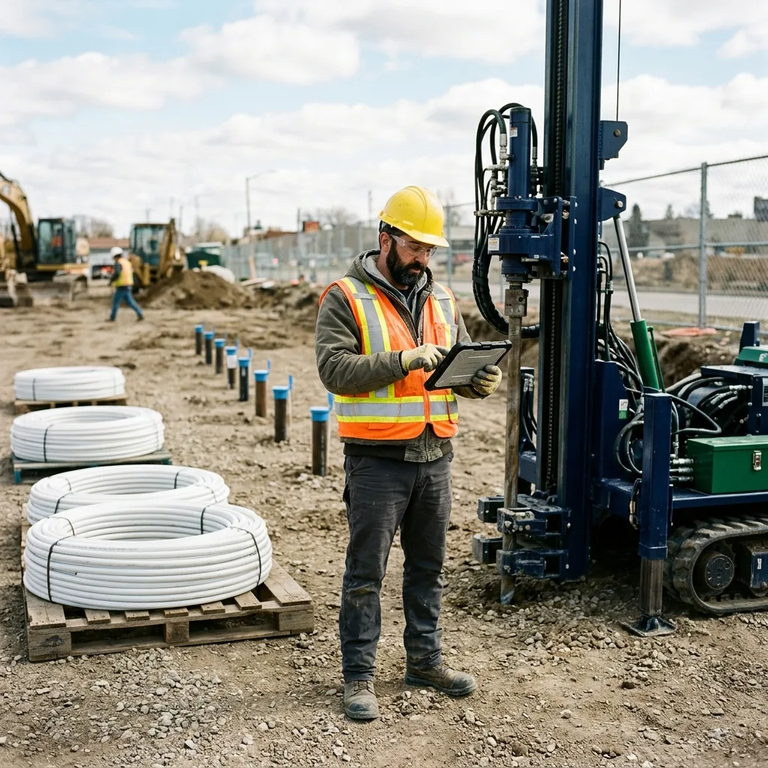
Geothermal Drillers & Loop Installers
Show clients what a given field can carry and what deeper holes, more holes or better grout would add, using the ground data from your thermal response tests.
Why It Matters
Solving the Hardest Parts of Geothermal Design
A Field You Cannot Resize
A borefield is drilled once and stays for the life of the building. A field can meet its peak for years and then slowly drift out of range. CogenS rolls the ground forward over the full study period so you see that before you drill.
Efficiency Depends on Last Summer
A ground-source heat pump faces a loop whose temperature is the running total of everything it has done. CogenS simulates that loop temperature and reads the heat pump against it, instead of assuming one.
Keeping the Ground in Balance
You set how far the ground may end each year out of balance. The optimizer ranks balanced designs first and tells you plainly when no combination can keep the field in range. If more than 2% of the load goes unserved, the report withholds NPV, IRR and payback.
Start Your Geothermal Project
Start free and use your free full model runs on a geothermal project, or subscribe to the Geothermal Suite from $500/user/mo ($5,000/user/yr). Teams of 2 pay $450 per user, and 3 or more pay $400 per user.