Evaluating LCOE and Permitting Risk for Gigawatt-Scale Data Center Microgrids
Levelized Cost of Energy (LCOE)
Capital & Operational Expenditure
Permitting Risk
Emissions & Regulatory Compliance
1 GW Microgrid Viability
Technoeconomic Feasibility
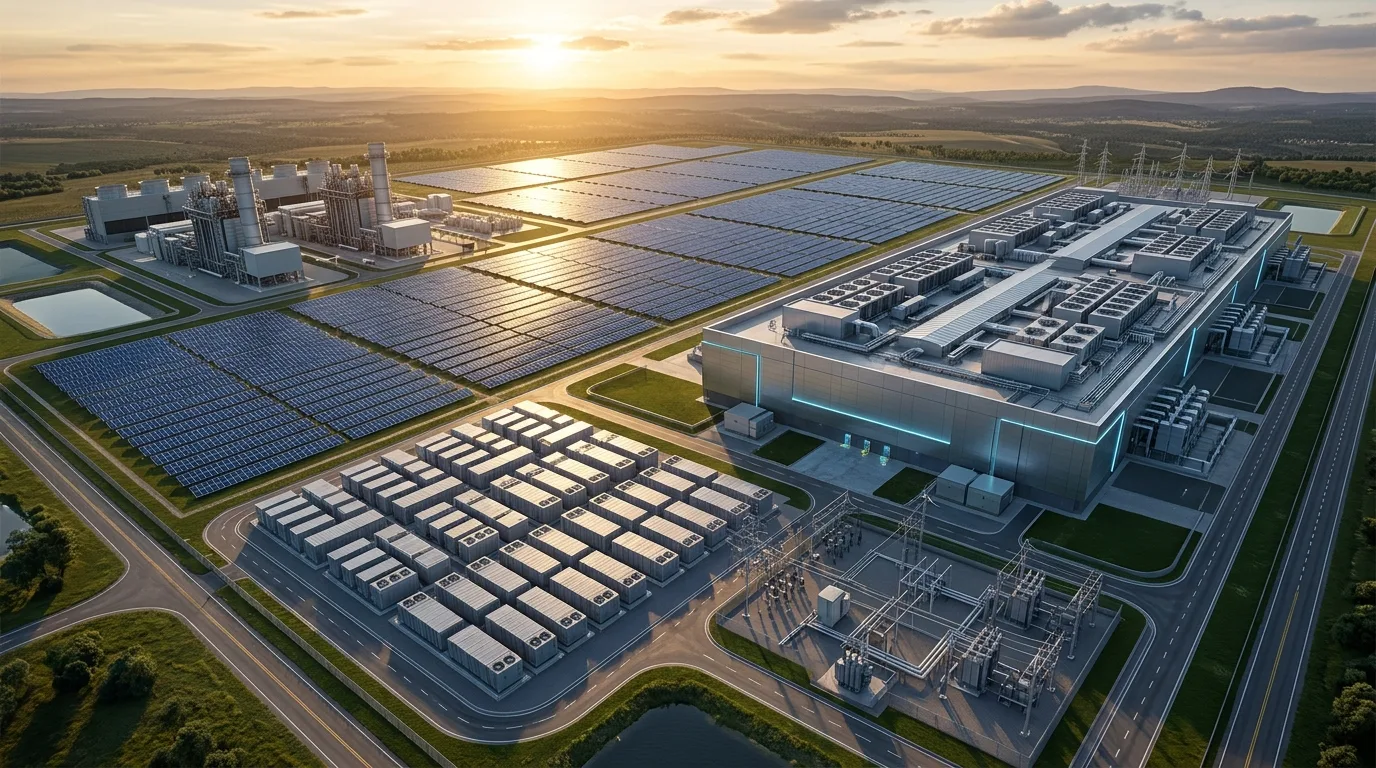
Data center operators increasingly target 1,000 MW (1 GW) thresholds to accommodate high-density artificial intelligence compute clusters. Scaling onsite power generation to this magnitude transforms a facility from a standard commercial off-taker into a utility-scale power producer. At this scale, accurately evaluating the Levelized Cost of Energy (LCOE) and navigating local permitting risks become the primary drivers of project viability. Unlike conventional standby systems typically utilized for short runtimes, gigawatt-scale microgrids operate as prime power sources. This shifts the financial model from a purely capital expenditure (CAPEX) focus to a complex technoeconomic analysis of operational expenditures (OPEX), fuel logistics, thermal efficiency, and environmental compliance. Properly aligning these variables is critical for minimizing risk and ensuring the continuous, reliable baseload power required by hyperscale infrastructure.
Introduction: The Collision of AI Power Demand and Grid Constraints
The rapid deployment of machine learning hardware requires massive power density. Rack densities frequently exceed 40 kW, driving total campus power loads well beyond the existing capacity of regional transmission networks. Utilities typically mandate multi-year system impact studies and extensive grid upgrades to accommodate loads of this size. At the end of 2023, Lawrence Berkeley National Laboratory reported that 11,841 projects were actively seeking grid interconnection in the U.S., representing 2,598 GW of generation and storage capacity. This severe grid congestion creates a critical bottleneck. Facility developers must secure large-scale, onsite generation to meet immediate power demands, balancing the urgency of artificial intelligence deployment schedules against the realities of localized grid limitations.
Why Hyperscale Data Centers Require Gigawatt-Scale On-Site Generation
Many hyperscale data centers require gigawatt-scale onsite generation primarily because legacy grid infrastructure often lacks the available capacity and transmission pathways to deliver 1,000 MW to a single geographic node. Moving from grid-dependence to prime-power microgrids can allow operators to dictate their own timelines. A 1 GW onsite plant generates power directly beside the load, typically limiting transmission losses and bypassing substation constraints. By generating power locally, facilities can provide the continuous baseload energy required for AI training algorithms without waiting for extensive utility upgrades. Onsite generation also provides engineers the flexibility to design specialized cooling and electrical distribution networks, integrating power production directly into the data center's thermal management strategy.
Balancing Speed-to-Market with Long-Term Energy Economics
Deploying AI infrastructure quickly often conflicts with achieving the lowest long-term Levelized Cost of Energy (LCOE). Expediting a 1 GW power plant typically favors aeroderivative natural gas turbines or reciprocating engines due to their mature supply chains and rapid installation times. However, prioritizing speed can lock a facility into volatile fuel markets and lower thermodynamic efficiencies compared to slower-to-build combined-cycle gas turbines (CCGT). Developers must quantify the financial trade-off: the immediate revenue generated by deploying AI servers quickly versus the aggregate operational expenditures (OPEX) incurred over a 20-year lifespan. Financial models must account for varying fuel prices and efficiency degradation to accurately reflect the balance between rapid deployment and sustained economic performance.
Deconstructing Data Center Microgrid LCOE at the Gigawatt Scale
Calculating the Levelized Cost of Energy (LCOE) for a gigawatt-scale microgrid requires analyzing the total life-cycle cost divided by the total electrical energy produced. The National Renewable Energy Laboratory (NREL) frequently emphasizes that LCOE models must integrate capital costs, operational costs, fuel expenses, and capacity factors. For a 1 GW data center, subtle variations in the capacity factor—driven by maintenance downtime or load fluctuations—drastically alter the final LCOE metric ($/MWh). A rigorous model captures the specific capital expenditures of prime power generation and the continuous operational expenditures of fuel and maintenance. Understanding this breakdown allows operators to isolate inefficiencies and strategically allocate capital to lower the total cost per megawatt-hour.
Capital Expenditures (CapEx): Prime Power, Switchgear, BESS, and Real Estate
Capital expenditures (CAPEX) for a gigawatt-scale microgrid extend far beyond the prime movers. While natural gas turbines or arrays of reciprocating engines represent the core equipment cost, electrical balance-of-plant requires equal financial scrutiny. A 1 GW facility demands heavy-duty switchgear, step-up transformers, and extensive medium-voltage distribution networks to safely route power. Integrating Battery Energy Storage Systems (BESS) for grid-forming capabilities adds significant upfront costs per installed megawatt. Furthermore, real estate acquisition costs scale non-linearly; generating 1 GW onsite requires substantial land for generation equipment, fuel storage, and necessary setback distances for noise and emissions dispersal, all of which heavily impact the initial financial outlay.
Operational Expenditures (OpEx): Fuel Supply, O&M, and Carbon Compliance
Operational expenditures (OPEX) typically dominate the lifetime costs of prime power microgrids. For combustion-based systems, securing a reliable fuel supply—such as long-term natural gas purchase agreements—dictates the baseline energy cost. Operations and maintenance (O&M) require specialized onsite personnel, routine replacement of consumables, and major overhaul cycles for turbines or engines. Furthermore, regulatory frameworks increasingly internalize the cost of emissions. Operating a 1 GW fossil-fueled microgrid generates significant greenhouse gases, meaning carbon compliance costs, emissions trading credits, or local carbon taxes must often be factored directly into the OPEX. These variable costs fluctuate, requiring robust sensitivity analysis to ensure the facility remains economically competitive over a multi-decade operating life.
Financial Structuring: WACC, EaaS (Energy-as-a-Service), and EPC Project Finance
Traditional EPC Finance
Operator assumes high initial CAPEX & manages debt-to-equity.
Energy-as-a-Service (EaaS)
Third-party funds CAPEX; Operator signs long-term PPA.
Funding a gigawatt-scale microgrid requires sophisticated financial structuring to manage the Weighted Average Cost of Capital (WACC). Developers often utilize Engineering, Procurement, and Construction (EPC) project finance models, isolating the generation asset's risk from the core data center operations. Alternatively, the Energy-as-a-Service (EaaS) model transfers CAPEX and O&M responsibilities to a third-party energy developer. In an EaaS arrangement, the data center operator signs a long-term Power Purchase Agreement (PPA) for the generated electricity, converting massive upfront capital requirements into predictable, ongoing operational expenses. Optimizing the debt-to-equity ratio and securing favorable interest rates are critical steps, as a high WACC can erode the projected economic benefits of self-generation. To access premium modeling tools for these structures, visit our portal and sign up or login.
Technoeconomic Evaluation of Prime Power Generation Technologies
Selecting the appropriate generation technology requires balancing thermal efficiency, capital costs, and emissions profiles. Technoeconomic evaluations compare the net power output and fuel consumption rates—specifically noting Lower Heating Value (LHV) versus Higher Heating Value (HHV) efficiencies—to determine the baseline operating costs. Few technologies suit a continuous 1 GW load perfectly across all conditions. Technologies are evaluated on their ramp rates, part-load efficiencies, and physical footprint. A proper evaluation avoids false absolutes; a system is rarely the universally "best" option, but rather the most optimal fit for a specific site's climate, fuel availability, and load profile. This rigor ensures the selected generation mix aligns with the facility’s specific constraints.
Natural Gas Turbines and Reciprocating Engines: Baseline Economics
Natural gas generators currently form the baseline for most gigawatt-scale data center microgrids due to their high power density and reliable fuel supply chains. Simple-cycle aeroderivative turbines offer rapid startup times and moderate CAPEX but typically yield electrical efficiencies around 40% (LHV). Combined-cycle gas turbines (CCGT) capture exhaust heat to drive a secondary steam turbine, pushing net electrical efficiencies beyond 60% (LHV), significantly lowering long-term fuel OPEX at the cost of higher initial CAPEX and water consumption. Alternatively, large-bore reciprocating engines provide excellent part-load efficiency and modular scalability. The technoeconomic choice between turbines and engines depends heavily on whether the data center operates at a steady 1 GW baseload or experiences dynamic load fluctuations.
Solar PV Paired with Battery Energy Storage Systems (BESS)
Solar PV
Intermittent Energy (MWh)
Lithium-Ion BESS
Firm Power (MW) & Grid-Forming
Integrating Solar Photovoltaics (PV) paired with Battery Energy Storage Systems (BESS) introduces renewable generation into the microgrid, though achieving 1 GW of firm capacity solely from PV remains highly land-intensive. Solar PV generates energy (MWh) intermittently, while BESS provides the necessary power (MW) discharge during transient events or nighttime operations. In a hybrid microgrid, BESS typically operates as a grid-forming asset, stabilizing voltage and frequency. While the CAPEX for utility-scale PV and lithium-ion BESS is substantial, the near-zero marginal fuel OPEX significantly reduces the blended Levelized Cost of Energy (LCOE) over time. However, detailed hourly dispatch modeling is required to properly size the BESS and prevent load loss during extended periods of low irradiance.
Emerging Baseload: Hydrogen Fuel Cells, Geothermal, and Small Modular Reactors (SMRs)
As data centers aim for lower carbon footprints, emerging baseload technologies offer fossil-free alternatives for gigawatt-scale power. Small Modular Reactors (SMRs) provide exceptional power density and continuous generation without greenhouse gas emissions, though they face prolonged regulatory approval timelines and high first-of-a-kind CAPEX. Next-generation geothermal systems offer consistent baseload power (kW) and energy (kWh) but rely heavily on specific geographic heat resources. Hydrogen fuel cells provide clean power via electrochemical conversion, offering high electrical efficiencies without combustion. However, hydrogen's low volumetric energy density complicates onsite storage, and the current OPEX for green hydrogen fuel remains prohibitive for continuous 1 GW operation. These technologies represent viable future pathways, requiring careful tracking of cost-reduction curves.
How Generation Mix Optimization Drives Down Data Center Microgrid LCOE
= Minimized Part-Load Inefficiency & Lower Blended LCOE
It is rare for a single generation source to perfectly balance CAPEX, OPEX, and emissions for a 1 GW microgrid. Optimization often relies on a hybrid approach, dispatching different assets based on real-time economics. A facility might utilize CCGTs for stable baseload power, solar PV to offset daytime fuel consumption, and BESS to handle transient spikes in AI computational loads. By employing advanced dispatch algorithms, operators can minimize part-load inefficiencies and reduce total fuel burn. This generation mix optimization lowers the aggregate Levelized Cost of Energy (LCOE) by leveraging the strengths of each technology. Detailed technoeconomic modeling ensures that the integrated system operates at maximum efficiency, minimizing wasted energy and maximizing the financial return on the installed infrastructure.
Navigating the Permitting Minefield for Utility-Scale On-Site Power
Constructing a 1 GW power plant triggers rigorous environmental and regulatory scrutiny, transforming the permitting process into a major project risk. Regulators evaluate air quality impacts, water consumption, and land-use zoning. Because these microgrids operate continuously as prime power rather than intermittent emergency backup, they are typically subject to stringent federal and state standards. Delays in obtaining these permits directly impact the project schedule, delaying the deployment of AI infrastructure and deferring revenue. Developers must engage in early-stage consultations with regulatory bodies and local communities, embedding compliance strategies directly into the initial engineering designs to prevent costly redesigns or fatal flaws late in the development cycle.
Air Quality Permitting (Title V, NSR) and Local Emissions Thresholds
EPA Major Source Classification
Triggers Title V Operating Permit & New Source Review (NSR)
A 1 GW combustion-based microgrid easily exceeds the major source thresholds for air pollutants. Under the Environmental Protection Agency (EPA), a major source has actual or potential emissions at or above 100 tons/year for a criteria air pollutant in many areas. This typically necessitates obtaining a Title V Operating Permit and undergoing New Source Review (NSR). Depending on the attainment status of the region, NSR requires demonstrating that the facility will utilize the Best Available Control Technology (BACT) or the Lowest Achievable Emission Rate (LAER), such as Selective Catalytic Reduction (SCR) for nitrogen oxides (NOx) and oxidation catalysts for carbon monoxide (CO). Navigating Title V and NSR requires complex atmospheric dispersion modeling to prove that local emissions thresholds will not be breached, a process that frequently dictates the final allowable size and technology of the generation assets.
Environmental Impact Assessments (EIA), Land-Use Zoning, and NEPA Compliance
Depending on the jurisdiction and funding sources, a gigawatt-scale microgrid often triggers comprehensive Environmental Impact Assessments (EIA) or compliance with the National Environmental Policy Act (NEPA). These assessments evaluate the project's holistic impact on local ecosystems, traffic patterns, and community noise levels. Land-use zoning presents an additional hurdle; parcels zoned for commercial data centers may not legally permit utility-scale power generation. Developers must secure variances or rezone the land, subjecting the project to public hearings and local political risk. Successfully managing this process requires demonstrating economic benefits to the municipality while rigidly adhering to environmental mitigation requirements, ensuring the physical footprint aligns with local ordinances.
Water Rights and the Energy-Water Nexus in Prime Power Cooling
The energy-water nexus is a critical constraint for 1 GW microgrids, particularly when utilizing Combined-Cycle Gas Turbines (CCGT) or water-cooled AI server racks. A CCGT plant requires significant water volumes for cooling tower makeup and steam cycle blowdown. In water-stressed regions, securing the necessary water rights can be more challenging than obtaining air permits. Developers must negotiate with local water authorities or invest heavily in dry-cooling technologies, such as air-cooled condensers. While dry cooling minimizes water consumption, it typically imposes a parasitic load and reduces the thermodynamic efficiency of the power plant on hot days, subsequently increasing the fuel OPEX and the overall Levelized Cost of Energy (LCOE).
Interconnection vs. Island Mode: Regulatory and Economic Trade-Offs
Interconnected
Grid Backup, Export Potential, Queue Delays, Standby Tariffs.
Island Mode
Rapid Deployment, Full Autonomy, Requires Grid-Forming & Redundancy.
Operating a 1 GW microgrid presents a fundamental choice: interconnect with the regional grid or operate in complete isolation (island mode). Interconnection provides a secondary layer of reliability and the ability to export excess power, but it subjects the project to lengthy utility study queues and complex regulatory tariffs. Conversely, operating in island mode bypasses the utility interconnection process entirely, allowing for rapid deployment. However, islanded systems must self-supply required voltage and frequency regulation (grid-forming) and maintain substantial spinning reserve capacity to handle sudden load rejections or generator trips. The economic trade-off centers on balancing the CAPEX of redundant onsite equipment against the time-to-market advantages of bypassing the local utility.
The Value of Bypassing ISO/RTO Interconnection Queue Delays
The primary driver for operating in island mode is bypassing the massive backlogs in Independent System Operator (ISO) and Regional Transmission Organization (RTO) queues. Data from the Lawrence Berkeley National Laboratory indicates that the median duration from a connection request to commercial operation has stretched to 55 months for 200+ MW projects built in 2023, with wait times continuing to rise. For a hyperscale data center, a four-year delay in AI cluster deployment represents billions in deferred revenue. By severing ties with the ISO/RTO and generating 1 GW entirely on-site, developers recapture control over their construction schedules. This time-to-market value often outweighs the increased capital costs required to build a fully self-sufficient microgrid.
Navigating Standby Charges and Complex Utility Tariff Structures
Billed for grid capacity reservation, regardless of actual energy (kWh) consumed.
If a 1 GW microgrid chooses to remain interconnected for reliability, the data center must navigate highly complex utility tariff structures. Utilities typically impose substantial standby or demand charges (measured in $/kW) to maintain the transmission infrastructure necessary to serve the full 1 GW load if the onsite generation fails. These capacity-based charges apply regardless of how much energy (kWh) the grid actually delivers. Facility engineers must carefully model these tariffs against their operational profile. In many jurisdictions, the monthly financial burden of standby charges can severely degrade the economic viability of self-generation, forcing operators to implement sophisticated load-shedding schemes to minimize peak grid reliance during forced microgrid outages.
Lowering Net LCOE by Monetizing Excess Capacity via Grid Services
An interconnected 1 GW microgrid can lower its net Levelized Cost of Energy (LCOE) by monetizing excess generation and operational flexibility. If the local market permits, the facility can export surplus power during periods of peak grid pricing. Furthermore, microgrids equipped with fast-responding assets like Battery Energy Storage Systems (BESS) or aeroderivative turbines can participate in ancillary service markets, providing frequency regulation or spinning reserves to the local grid operator. This transforms the power plant from a pure cost center into a revenue-generating asset. Accurate technoeconomic models must forecast these variable market revenues and subtract them from the aggregate OPEX, yielding a highly competitive net LCOE for the data center campus.
Quantifying and Pricing Permitting Risk into the Financial Model
Permitting Delays = Financial Liability
Uncertainty must be converted into projected cash flow adjustments and contingency budgets.
Permitting risk is not merely an administrative hurdle; it is a quantifiable financial liability that must be priced into the gigawatt-scale microgrid's financial model. Delays in obtaining air permits or zoning approvals push back the commercial operation date, increasing capitalized interest during construction and deferring AI compute revenue. Financial models must incorporate probability-weighted scenarios that reflect potential schedule extensions or the cost of mandatory environmental mitigations, such as upgrading to costlier emissions control technologies. By translating regulatory uncertainty into specific dollar values—adjusting the required contingency budgets and projected cash flows—developers can accurately assess the true risk-adjusted viability of the power generation project.
The Cost of Time: How Schedule Delays Impact NPV and IRR
In data center economics, the cost of time is extreme. Schedule delays directly degrade the project's Net Present Value (NPV) and Internal Rate of Return (IRR). If a 1 GW onsite generation project is delayed by 12 months due to a protracted Environmental Impact Assessment (EIA), the capital deployed often remains stranded, generating zero return while accruing financing costs. Furthermore, the inability to power the AI server racks delays the monetization of the compute infrastructure itself. Financial models must precisely calculate this degradation; a delayed start date shifts projected cash flows further into the future, heavily discounting their present value and frequently turning a marginal IRR into an unacceptable financial profile.
Utilizing Monte Carlo Simulations for Risk-Adjusted LCOE Projections
To accurately quantify uncertainty, financial analysts utilize Monte Carlo simulations to generate risk-adjusted LCOE projections. Rather than relying on single-point estimates for fuel prices, capacity factors, or permitting timelines, a Monte Carlo simulation runs thousands of iterations using statistical distributions for each input variable. This reveals the probability of various LCOE outcomes for the 1 GW microgrid. For example, it might show a 10% chance that prolonged natural gas price spikes combined with regulatory delays will push the LCOE above acceptable thresholds. This probabilistic approach prevents false confidence in baseline models, allowing developers to ensure sufficient financial buffers are in place to absorb worst-case technoeconomic scenarios.
Risk Mitigation for Developers: Phased Deployments and Modular Construction
250 MW
+250 MW
+500 MW
Developers frequently utilize phased deployments and modular construction to mitigate capital and schedule risks. Rather than constructing a monolithic 1 GW power plant, the facility is built in sequential blocks—such as 100 MW or 250 MW increments. This modular approach allows the data center to energize its initial server clusters and begin generating revenue while subsequent power phases are still under construction. Additionally, smaller initial generation capacities may fall under less stringent local permitting thresholds, allowing for faster initial deployment. Modular reciprocating engines or containerized Battery Energy Storage Systems (BESS) minimize onsite construction time, ensuring that power generation capacity closely tracks actual load growth and prevents massive upfront overcapitalization.
Future-Proofing Microgrid Assets Against Regulatory Shifts
Multi-Decade Asset Strategy
Engineering physical flexibility today to prevent stranded assets and OPEX spikes under future climate legislation.
Gigawatt-scale microgrids are multi-decade assets operating in a rapidly shifting regulatory environment. Future-proofing these facilities requires engineering flexibility directly into the initial design to prevent the assets from becoming stranded due to stringent future climate legislation. This involves specifying generation equipment that can adapt to lower-carbon fuels or integrating spatial layouts that accommodate future emissions control technologies. Anticipating these shifts prevents catastrophic future OPEX spikes. By designing for adaptability, facility owners ensure their onsite power systems can comply with evolving environmental standards without requiring full-scale replacement, thereby protecting the long-term integrity of the project's initial Levelized Cost of Energy (LCOE) projections.
Designing for Hydrogen Readiness and Carbon Capture (CCUS) Integration
To future-proof combustion assets, engineers increasingly specify natural gas turbines that are hydrogen-ready. While a plant may currently burn 100% natural gas, newer turbine combustors can handle increasing volumetric blends of hydrogen, allowing for a transition to zero-carbon fuel as supply chains mature. Additionally, the site layout must reserve physical space and auxiliary power capacity for future Carbon Capture, Utilization, and Storage (CCUS) equipment. Retrofitting CCUS requires significant footprint for amine absorbers and compression equipment, as well as parasitic load considerations. Planning for this integration on day one ensures the 1 GW microgrid can physically and economically adapt to stringent zero-emissions mandates in the future.
The Impact of Future Carbon Pricing on Data Center Microgrid LCOE
Future carbon pricing mechanisms—whether through direct carbon taxes or cap-and-trade systems—pose a severe risk to the operational expenditures (OPEX) of fossil-fueled microgrids. For a 1 GW natural gas plant running at high capacity factors, the annual carbon dioxide emissions are massive. If legislation imposes a $50 or $100 per ton cost on CO2, the LCOE will spike significantly, potentially rendering the onsite generation more expensive than utility procurement. Technoeconomic models must evaluate various carbon pricing scenarios over the asset's lifespan. Understanding this sensitivity helps justify the higher upfront CAPEX required for integrating solar PV, long-duration energy storage, or hydrogen-capable equipment, as these investments hedge directly against future carbon market volatility.
Case Study: Modeling a 1 GW Hybrid Microgrid for an AI Data Center Campus
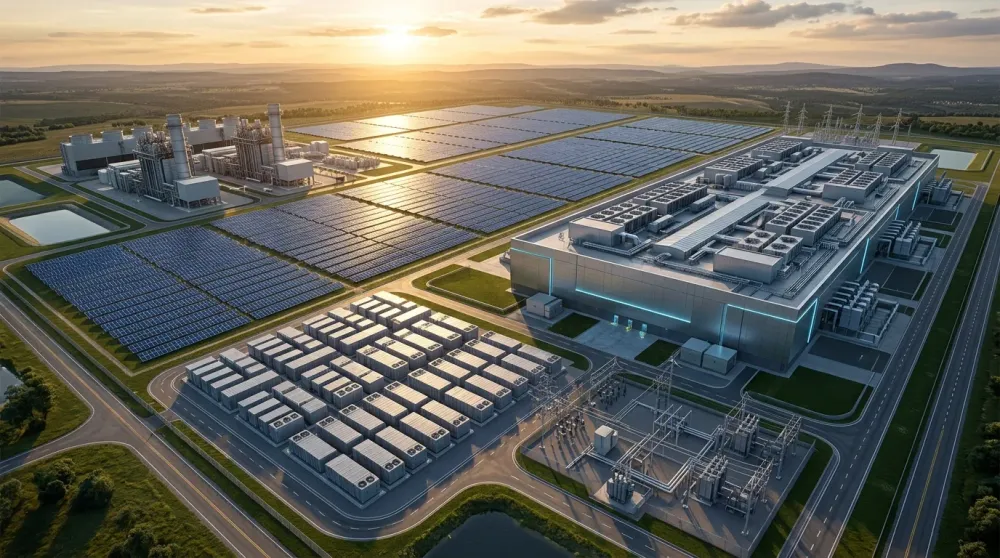
To synthesize these variables, we examine a technoeconomic model for a hypothetical 1 GW hybrid microgrid powering an AI campus. The study evaluates the capital expenditures (CAPEX), operational expenditures (OPEX), and permitting timelines required to deliver continuous, utility-scale power. By comparing a standard fossil-fuel approach against an optimized mix of renewable and thermal assets, the model demonstrates how variations in efficiency, fuel costs, and environmental compliance impact the final Levelized Cost of Energy (LCOE). This case study provides concrete data on how engineering choices dictate financial outcomes, illustrating the delicate balance required to achieve both speed-to-market and long-term economic sustainability for hyperscale loads.
Baseline Scenario: 100% Natural Gas Generation vs. Utility Procurement
The baseline scenario models a 1 GW microgrid utilizing exclusively combined-cycle gas turbines (CCGT) compared against purchasing power directly from the utility. The utility option may offer predictable tariff rates but typically includes a major hurdle: a multi-year interconnection delay that stalls AI deployment. The CCGT microgrid bypasses this delay but requires immense upfront CAPEX and exposes the operator to 20 years of natural gas price volatility. While the baseline microgrid achieves a favorable steady-state LCOE due to the high thermal efficiency of the combined cycle (often exceeding 60% LHV), the financial model remains highly sensitive to fuel supply constraints and incoming carbon compliance costs, presenting a rigid operational profile.
Optimized Scenario: Gas, Solar PV, and Long-Duration Energy Storage (LDES)
Zero-Margin Energy
Shifts Energy to Night
Firm Baseload & Backup
The optimized scenario models a hybrid 1 GW microgrid blending flexible natural gas reciprocating engines, a large-scale Solar PV array, and Long-Duration Energy Storage (LDES). In this architecture, the solar PV provides zero-marginal-cost energy during daylight, while the LDES shifts that energy to offset nighttime fuel consumption. The reciprocating engines operate dynamically, ramping up to cover gaps in renewable generation and maintain stringent reliability for the AI clusters. While this hybrid system demands a higher initial capital expenditure (CAPEX) than the baseline scenario, it drastically lowers the aggregate operational expenditure (OPEX) and emissions profile, creating a more resilient LCOE insulated against future carbon taxes and fuel price spikes.
Technoeconomic Results, LCOE Variances, and Permitting Timelines Compared
Comparing the models reveals clear technoeconomic variances. The baseline 100% gas scenario achieved commercial operation faster due to standard permitting but yielded a higher 20-year LCOE when applying Monte Carlo simulations that factored in carbon pricing. The optimized hybrid scenario faced more complex initial land-use zoning due to the extensive solar PV footprint, extending the permitting timeline by several months. However, the hybrid model ultimately delivered a 15% reduction in net LCOE over the project lifecycle, driven by minimized fuel OPEX and lower emissions liabilities. These results illustrate that accepting marginal schedule risk during the permitting phase can unlock profound, compounding financial benefits over the operational life of the asset.
Key Execution Takeaways for EPCs, ESCOs, and Facility Engineers
Equipment selection must directly address Title V emissions limits.
Physical plant design must match the financial OPEX modeled by ESCOs.
For Engineering, Procurement, and Construction (EPC) firms, Energy Service Companies (ESCOs), and facility engineers, the primary takeaway is the necessity of integrated planning. Electrical and thermal engineering do not exist in a vacuum separated from regulatory strategy and financial modeling. Equipment selection must directly address local permitting thresholds; for example, choosing prime movers with superior part-load efficiency to stay beneath Title V emissions limits. Furthermore, contracts must explicitly account for schedule flexibility to handle regulatory delays. Successfully executing a 1 GW microgrid requires cross-disciplinary alignment, ensuring that the physical plant built by the engineers precisely matches the financial performance projected by the ESCOs and capital providers.
Conclusion: Aligning Engineering, Economics, and Regulatory Strategy
Successfully deploying a gigawatt-scale microgrid demands the seamless alignment of engineering design, economic modeling, and regulatory strategy. Evaluating the Levelized Cost of Energy (LCOE) is not merely a spreadsheet exercise; it reflects physical realities regarding thermodynamic efficiency, fuel logistics, and emissions control. Likewise, permitting is not a secondary administrative task but a primary driver of project risk that directly impacts the Net Present Value (NPV). Operators who view these disciplines holistically can navigate the constraints of legacy grid infrastructure, delivering the massive, reliable power required for modern AI workloads while shielding their facilities from volatile fuel markets and future regulatory shifts.
The Critical Role of Integrated Early-Stage Feasibility Studies
Identify fatal flaws in month 1
Prevents millions in sunk costs
Integrated early-stage feasibility studies are the foundation of viable gigawatt-scale microgrids. Before major capital is committed, these studies must concurrently evaluate interconnection queue timelines, localized air quality regulations, and detailed LCOE projections based on site-specific weather and fuel data. Identifying a fatal flaw—such as a lack of available water rights for a planned CCGT cooling tower or an insurmountable zoning restriction—during month one prevents the catastrophic loss of millions in sunk engineering costs later. Rigorous feasibility studies ensure that the fundamental project assumptions are grounded in absolute, traceable facts, establishing a secure baseline for subsequent detailed design and financial procurement phases.
Final Thoughts on the Future of Gigawatt-Scale Data Center Power
Congested regional grid reliance
Localized, multi-asset power plants
As artificial intelligence compute requirements accelerate, the gigawatt-scale data center microgrid will transition from an extreme edge case to an industry standard. The reliance on heavily congested regional utility grids will increasingly give way to sophisticated, localized power generation hubs. Future facilities will likely operate as highly optimized, multi-asset power plants that happen to cool and power servers. To remain competitive, developers must master the intricate balance between deploying capital quickly and optimizing the long-term Levelized Cost of Energy (LCOE). The winners in this evolving landscape will be those who construct adaptable, resilient microgrids capable of navigating both the immediate demands of AI and the stringent environmental realities of the future.