Introduction
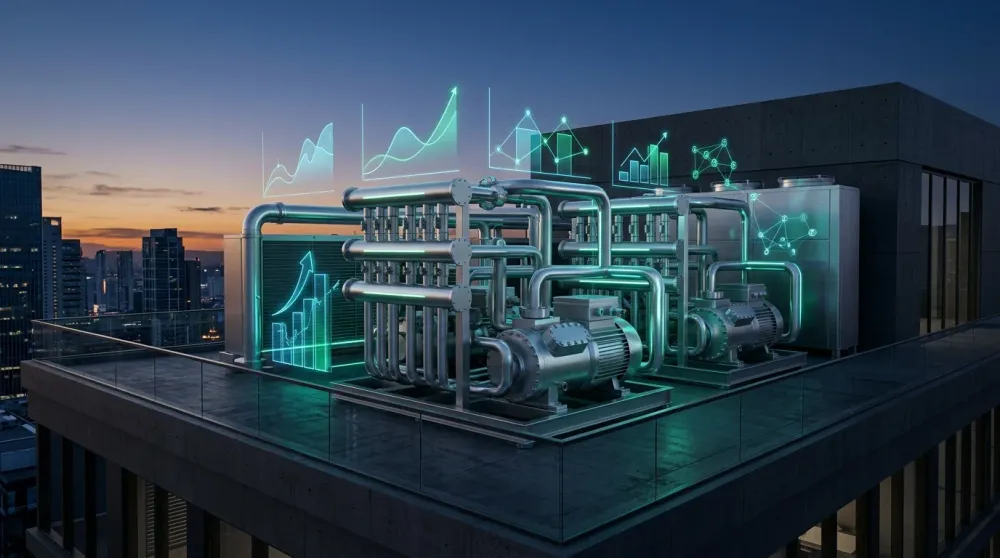
The transition toward building decarbonization frequently positions commercial heat pump systems as a central mechanism within modern energy portfolios. For Engineering, Procurement, and Construction (EPC) firms and Energy Service Companies (ESCOs), bridging the gap between mechanical system performance and financial viability requires robust technoeconomic models. Facilities typically replace conventional gas-fired boilers and standard rooftop air conditioning units with advanced air-source or water-source heat pumps to simultaneously manage heating and cooling loads. However, evaluating the strategic importance of this equipment relies on translating thermodynamic efficiency into verifiable economic returns. Engineers and project developers must accurately forecast how system utilization impacts the net operating income of a property. A detailed technoeconomic analysis merges these disciplines, helping verify that capacity constraints, seasonal degradation, and utility rate structures are accounted for before capital is deployed. Proper modeling typically prevents costly over-sizing and ensures that the financial projections align with the physical realities of the mechanical design.
1. Baseline Assessment and Core System Design
Evaluating a facility’s existing load profile is a necessary early step in most commercial heat pump deployments. Engineers typically rely on interval meter data and energy consumption baselines to separate base loads from weather-dependent heating and cooling demand. Technical sizing involves specifying the equipment in tons of refrigeration or kilowatts of thermal output, bound by the physical capacity constraints of the facility. Sizing a system strictly for peak winter heating without considering part-load cooling performance usually results in poor annual efficiency. Integration challenges frequently arise when pairing new variable-speed compressor technology with legacy HVAC, mechanical, and electrical infrastructure. For example, older buildings often feature low-temperature chilled water loops or high-temperature hot water baseboards that operate outside the optimal temperature lift of modern heat pumps. Consequently, the core system design must map the entering and leaving water or air temperatures against the manufacturer’s performance maps to verify that the equipment can meet the load under local ambient conditions without excessive reliance on auxiliary electric resistance heat.
2. Capital Expenditure (CAPEX) Estimation and EPC Logistics
Accurate capital expenditure (CAPEX) estimation extends far beyond direct equipment procurement. While the direct costs of variable refrigerant flow (VRF) units, compressors, and heat exchangers are heavily influenced by supply chain realities and raw material pricing, indirect costs often constitute a large portion of the total project budget. Engineering fees, environmental permitting, and EPC contractor margins must be explicitly modeled. Furthermore, upgrading legacy buildings frequently reveals hidden structural and mechanical upgrade costs. Retrofitting a gas-heated commercial building to an all-electric heat pump system usually requires upgrading the main electrical service panel to handle the increased ampacity. A National Renewable Energy Laboratory (NREL) electrification futures study indicates that overcoming these initial capital expenditures remains a primary hurdle. NREL projections suggest that commercial heat pumps for space heating in moderate climates could achieve cost parity with incumbent gas technologies over the next two decades [1], provided that supply chains mature and installation labor becomes standardized. (Source: nrel.gov)
3. Operational Expenditure (OPEX) and Lifecycle Cost Assessment (LCCA)
Lifecycle Cost Assessment (LCCA) models typically incorporate realistic operational expenditure (OPEX) forecasts to evaluate the long-term viability of commercial heat pumps. Direct OPEX includes scheduled maintenance, specialized labor for refrigerant handling, and comprehensive Operations and Maintenance (O&M) contracts. Beyond mechanical upkeep, analyzing utility rate structures is critical. A system that increases electrical consumption during peak hours can trigger punitive peak demand charges ($/kW), substantially offsetting the financial benefits of reduced volumetric energy charges ($/kWh). Technoeconomic models typically simulate hourly dispatch profiles against local tariffs to accurately project utility costs. Additionally, LCCA must account for system degradation and end-of-life replacement scenarios. Heat pump compressors and heat exchangers degrade over time, leading to lower operating efficiencies and eventual mechanical failure. Modeling these replacement cycles usually involves amortizing the future capital replacement cost over the 15- to 20-year expected lifespan of the equipment, providing asset managers with a true representation of the long-term cash flow requirements.
4. Quantifying Revenue Streams, Energy Savings, and Incentives
A project’s financial return depends on calculating accurate energy yields and mechanical efficiency gains. Commercial heat pumps achieve high efficiencies by moving heat rather than generating it via combustion. Research funded by the U.S. Department of Energy demonstrates that high-performance cold climate commercial heat pump prototypes can maintain reliable heating capacity at sub-zero ambient temperatures [2], resisting the capacity degradation historically observed in older technologies. (Source: energy.gov) These mechanical efficiency gains translate directly into reduced site energy consumption (kWh). To optimize the capital stack, developers routinely incorporate federal tax credits, state-level rebates, and custom utility incentives tied to decarbonization targets. Furthermore, advanced revenue streams can be monetized by utilizing the heat pump's thermal inertia for grid services. By pre-heating or pre-cooling a building, operators can participate in utility Demand Response (DR) programs, shedding electrical load during grid emergencies in exchange for capacity payments, thereby layering active grid revenues on top of passive energy savings.
5. Financial Modeling Metrics and Risk Mitigation
Translating mechanical performance into actionable investment data typically involves evaluating metrics like Net Present Value (NPV), Internal Rate of Return (IRR), Levelized Cost of Energy (LCOE), and discounted payback periods. For facility owners, a positive NPV indicates that the lifecycle energy savings and incentives exceed the CAPEX and OPEX when discounted at the firm’s cost of capital. LCOE is frequently used to compare the per-MWh cost of heating or cooling delivered by the heat pump against alternative technologies. Conducting sensitivity analyses on fluctuating energy prices, inflation rates, and equipment costs is a standard engineering practice to establish best- and worst-case scenarios. Identifying and mitigating technical risks—such as lower-than-expected part-load efficiencies—protects the financial model from real-world degradation. Energy professionals looking to streamline these complex evaluations often adopt standardized software platforms. For instance, developers can centralize their project data and financial assumptions by utilizing tools available when they register at https://jisenergy.com/sign-up-login/.
6. Project Delivery Models and Financing Structures
Deploying commercial heat pump systems requires selecting appropriate project delivery models and financing structures. Traditional capital financing relies on the facility owner directly funding the CAPEX through cash or commercial loans, leaving them responsible for ongoing OPEX and performance risks. Conversely, Energy as a Service (EaaS) models shift the upfront capital burden and technical risk away from the end-user. In an EaaS arrangement, a third-party developer owns and operates the equipment, charging the facility a volumetric rate for the delivered thermal energy. Energy Service Companies (ESCOs) frequently structure Energy Savings Performance Contracts (ESPCs) to guarantee a minimum threshold of energy savings. If the heat pumps fail to deliver the modeled mechanical efficiency, the ESCO typically compensates the facility owner for the shortfall. This risk allocation dictates how project developers, EPCs, and facility owners draft their contracts, ensuring that the party responsible for system sizing and installation also bears the financial consequences of underperformance.
7. Interconnection, Regulatory Compliance, and Standards
Electrifying commercial heating loads usually results in a substantial increase in site electrical demand, requiring rigorous adherence to regulatory compliance and building codes. Navigating utility interconnection studies is a critical phase; adding a large commercial heat pump plant can exceed the existing electrical service or local transformer capacity, triggering lengthy utility approval timelines and required infrastructure upgrades. System design must also adhere to standards like the National Electrical Code (NEC) for safe wiring and overcurrent protection, as well as local commercial building codes. Commercial building energy baselines and mechanical efficiency requirements are largely governed by standards such as ASHRAE 90.1. Updates to ASHRAE 90.1, such as the 2022 edition, frequently introduce expanded scopes and significant efficiency increases in the Integrated Energy Efficiency Ratio (IEER) for commercial rooftop units [3]. (Source: ashrae.org) Meeting these stringent environmental permitting standards supports alignment with corporate decarbonization mandates while helping secure eligibility for state and federal electrification incentives.
Practical Application Case Study: Real-World Commercial Heat Pump Systems Implementation
A representative technoeconomic feasibility study for a commercial office building demonstrates the practical realities of retrofitting a legacy gas boiler with a modular air-source heat pump system. An initial facility overview typically reveals peak winter heating loads that threaten to overload electrical infrastructure nearing its maximum capacity. Collaborative execution is critical; general contractors, electrical engineers, and HVAC specialists must coordinate to schedule service panel upgrades alongside mechanical demolition. The technoeconomic model justifies the elevated CAPEX by forecasting a reduction in annual energy charges and securing regional utility electrification rebates. Following commissioning, post-installation Measurement and Verification (M&V) protocols are deployed. Interval meter data confirms that the heat pumps operate reliably, closely tracking the manufacturer's performance curve. The M&V process validates the financial returns, demonstrating that the system achieves its targeted discounted payback period while substantially reducing the facility's Scope 1 greenhouse gas emissions.
Conclusion
The Value Proposition
Properly engineered commercial heat pump systems transform complex mechanical upgrades into high-performing, decarbonized financial assets with verified operational stability.
The technoeconomic value proposition of commercial heat pump systems relies on the precise alignment of mechanical engineering data and financial modeling. As facilities transition away from fossil fuels, heat pumps provide a verified pathway to decarbonize heating and cooling loads while offering long-term operational cost stability. However, realizing these benefits requires rigorous baseline assessments, accurate CAPEX and OPEX forecasting, and adherence to industry standards like ASHRAE 90.1. The strategic next steps for engineering firms, project developers, and facility managers involve standardizing their technoeconomic evaluation processes. By utilizing robust sensitivity analyses, exploring Energy as a Service (EaaS) financing structures, and planning for utility interconnection constraints early in the design phase, stakeholders can mitigate technical risks. Ultimately, a properly sized and financially optimized commercial heat pump installation functions not just as mechanical equipment, but as a high-performing financial asset within a modern energy portfolio.